Can AI Help You Avoid Scams? How Technology Can Protect You From Fraud Before You Lose Money

AI-powered scams are becoming harder to detect. Learn how artificial intelligence, identity verification, and practical precautions can help protect your money and personal information from fraud.

By Florita Bell Griffin, Ph.D. | Houston, TX | October 27, 2026

Scams have always depended on a simple idea: convince someone that a false story is real long enough for that person to act. The story may involve an overdue bill, a frightened grandchild, a suspicious bank transaction, an unexpected prize, a romantic relationship, or an urgent message from a government agency. What artificial intelligence is changing is not the basic purpose of the scam. It is changing how convincing the deception can become.

A fraudulent email once gave itself away through strange grammar, obvious spelling errors, or an awkward message that did not sound like the company it claimed to represent. Today, AI can help criminals create polished messages in seconds. A scammer can produce professional-looking correspondence, imitate the tone of a business, translate a message into several languages, create realistic photographs, and even reproduce a familiar voice. The Federal Trade Commission warns that scammers can use a short audio sample to clone the voice of a family member, creating an emergency call that may sound frighteningly real.

This is not a minor problem. The FTC reported that consumers said they lost about $3.5 billion to imposter scams in 2025, and imposter scams remained the most frequently reported category of fraud. The large financial losses matter, but the emotional design of these scams matters just as much. Scammers deliberately create fear, urgency, embarrassment, affection, or confusion because a person who is emotionally overwhelmed is less likely to slow down and verify what is happening.

Consider the family emergency scam. A person receives a telephone call and hears what sounds exactly like a son, daughter, grandchild, or close friend. The caller says there has been an accident, an arrest, a medical emergency, or some other crisis. Money is needed immediately, and there is always a reason the victim should not call anyone else. In an earlier era, recognizing that the voice did not sound quite right might have been enough to stop the scam. Voice cloning makes that form of reassurance less dependable.

The best defense is therefore changing. Instead of asking only, “Does this sound like the person?” we now need to ask, “Can I independently verify that this is the person?” If someone claiming to be a relative asks for money, hang up and call that person on a number you already know. If the person cannot be reached, contact another family member. Families can even agree on a private question, phrase, or detail that can be used during an emergency. A few minutes of independent checking can interrupt the emotional pressure on which the scam depends.

Bank impersonation scams use a similar method. A message may claim that suspicious activity has been detected and that money must be moved to a “safe” account. The caller may know the name of the bank, use a realistic-looking telephone number, or send a text that resembles an actual security alert. The FTC notes that some of the costliest impersonation scams begin with false bank security warnings designed to convince consumers to move their own money.

The safest response is to stop communicating through the message that created the alarm. Do not call the number in the suspicious text, click its link, or follow instructions from the caller. Instead, use the telephone number printed on the back of the bank card, enter the bank’s website manually, or open the institution’s official application. If there is real a problem with the account, it can be handled through a channel you know belongs to the bank.

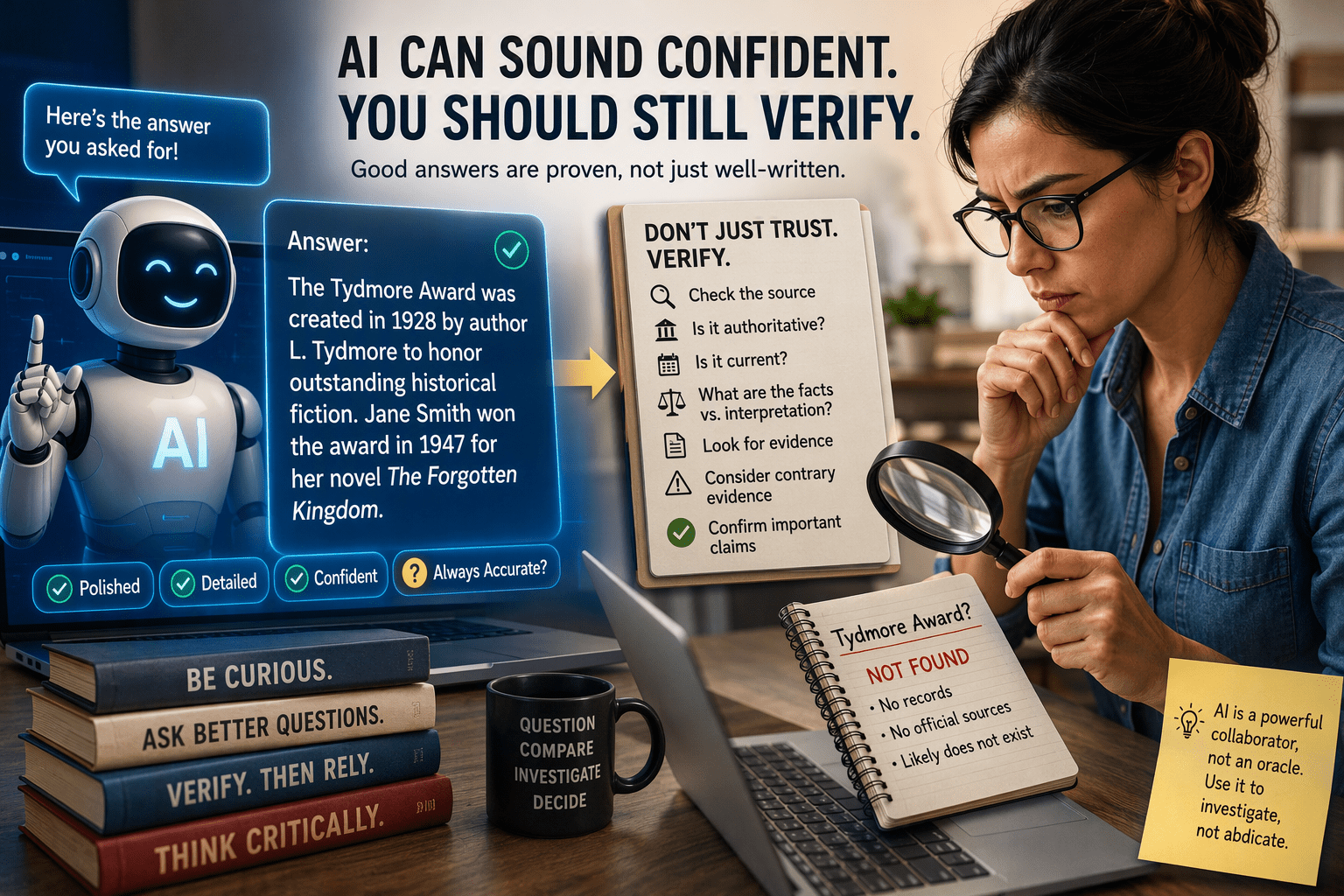
Artificial intelligence can also help consumers investigate suspicious communications. A questionable email can be examined for unusual requests, inconsistencies, or pressure tactics. AI can help explain what a technical-looking message is asking the recipient to do. It can compare the wording of a suspicious invoice with a genuine one or help someone create a list of questions to ask before sending money. Used in this way, AI becomes part of the defense rather than part of the deception.

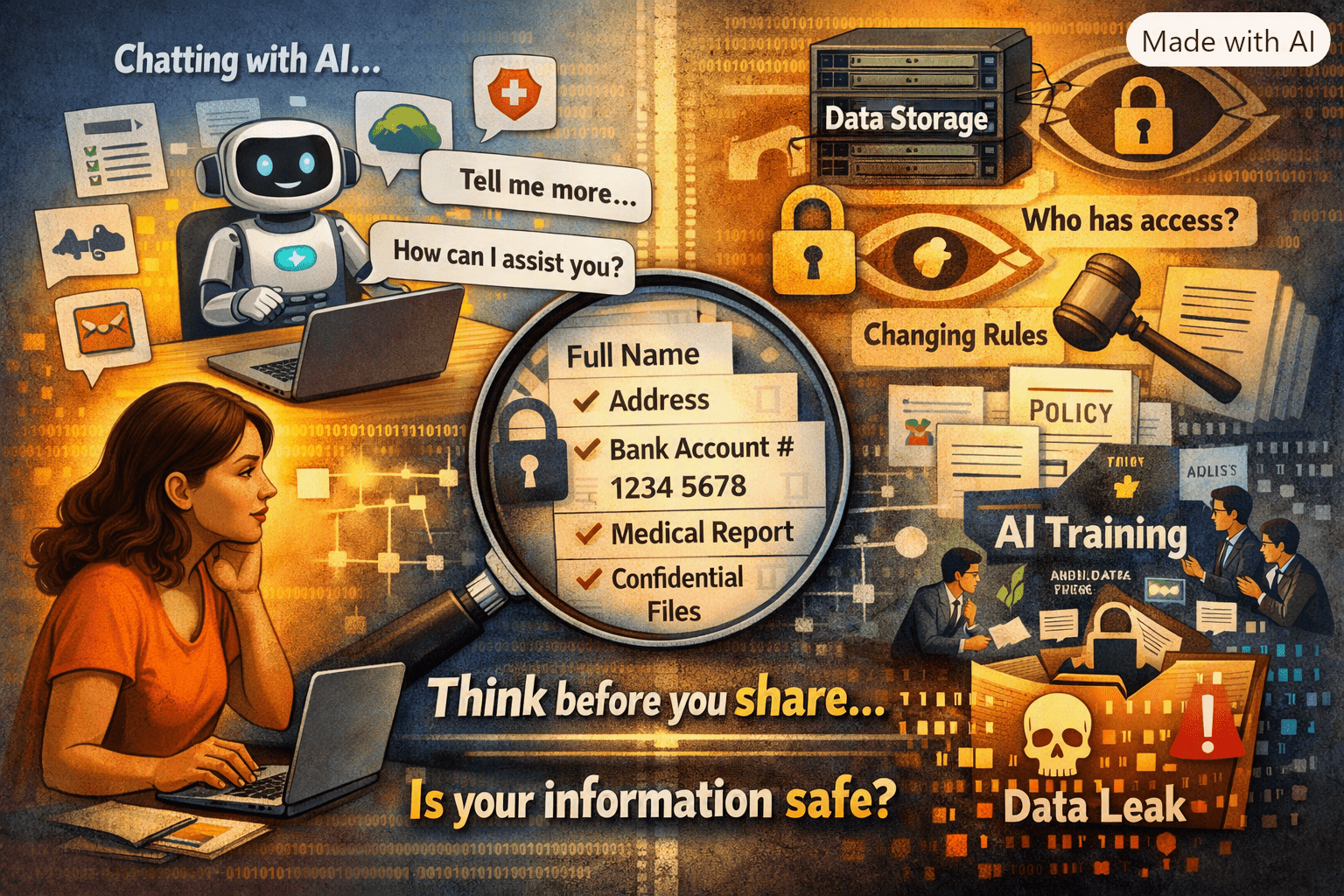
People should still avoid placing sensitive information into an AI system merely to investigate a scam. An entire bank account number, Social Security number, password, or security code is rarely necessary. The suspicious wording can often be examined after personal information has been removed. The goal is to use technology to understand the situation without exposing additional private information.

Romance scams present a different challenge because they develop slowly. A stranger met online may spend weeks or months building trust before asking for financial help. AI can make the deception more sophisticated by helping a criminal maintain long conversations, create believable photographs, or produce messages that seem caring and personal. A person who believes a genuine relationship has developed may be far more willing to overlook warning signs when money eventually enters the conversation.

The most important rule remains remarkably simple: do not send money to someone you have never met and independently verified merely because the relationship feels emotionally real. A photograph is no longer enough to prove identity, and even a live-looking digital interaction may not tell the whole story. Affection should not eliminate verification, particularly when investment opportunities, loans, emergencies, cryptocurrency, gift cards, or financial transfers suddenly become part of the relationship.

Artificial intelligence can also help criminals create fake businesses and false online identities. A professional website can be built quickly. Product photographs can be generated. Customer testimonials can be fabricated, and fake profiles can make a company appear established. This means consumers need to look beyond appearance. A beautiful website is not evidence that a business is legitimate.

Before making an unfamiliar purchase or investment, look for independent information about the company rather than relying exclusively on what the company says about itself. Search the business name along with words such as “complaint,” “scam,” or “review.” Verify professional licenses where relevant. Check whether the contact information leads to an established organization, and be especially cautious when the payment method makes recovery difficult.

Payment methods themselves provide clues. Scammers frequently prefer methods that are fast and difficult to reverse, including wire transfers, cryptocurrency, payment applications, and gift cards. The FTC repeatedly warns consumers that requests to purchase gift cards and provide the numbers are a common sign of fraud. A legitimate government agency, utility company, or business should not require someone to rush to a store, buy gift cards, and read the codes over the telephone.

The ability to slow down may become one of the most valuable skills in the AI age. Scammers want immediate action because time works against them. The longer a person thinks, calls someone else, checks a website, contacts a bank, or asks a family member for a second opinion, the greater the chance that the deception will collapse.

This is particularly important for families. Talking about scams before one occurs can remove some of the embarrassment that causes victims to remain silent. Older adults should not be treated as though they are incapable of protecting themselves, and younger people should not assume they are immune. Intelligent, educated, technologically experienced people are scammed every day because the fraud reaches them at the right emotional moment.

AI may make scams more convincing, but it can also help people become better prepared. The strongest protection is a combination of technology and human judgment: good spam filters, fraud alerts, identity verification, careful use of AI tools, family communication, and a willingness to stop when something feels urgent.

The most important change may be learning that familiar appearances no longer guarantee familiar identities. A voice can be copied, an email can be beautifully written, a photograph can be generated, and a caller ID can be falsified. In this new environment, trust should increasingly be based on verification rather than appearance.

Artificial intelligence is making deception more sophisticated, but sophistication does not make a scam unbeatable. Most scams still depend on the same human weaknesses they always have: urgency, secrecy, fear, greed, loneliness, and the desire to help someone we love. When people recognize those pressures and create the habit of checking before acting, technology can become part of the protection rather than simply another tool in the hands of the scammer.

© 2026 Truth Seekers Journal. Published with permission from the author. All rights reserved.

Related articles:

Will AI Change Your Job Even If It Doesn’t Replace It? What Everyday Workers Should Expect

Your Children Are Growing Up With AI: What Parents and Grandparents Need to Understand

What Happens When Your Car Starts Thinking for You? AI, Driving, and the Road Ahead

Who Owns What AI Creates? Your Photos, Your Voice, Your Writing, and the New Question of Digital Ownership

What Happens When AI Becomes Part of Healthcare? What Patients Should Know Before the Machine Helps Make the Decision

AI Can Save You Time, but Can It Make You Smarter?

Living With AI: How It Is Changing Work, Family, and Community

When Systems Forget Who They Were Built For     

Why Familiarity Is Not the Same as Understanding 

What is AutoLore?

Truth Seekers Journal thrives because of readers like you. Join us in sustaining independent voices.
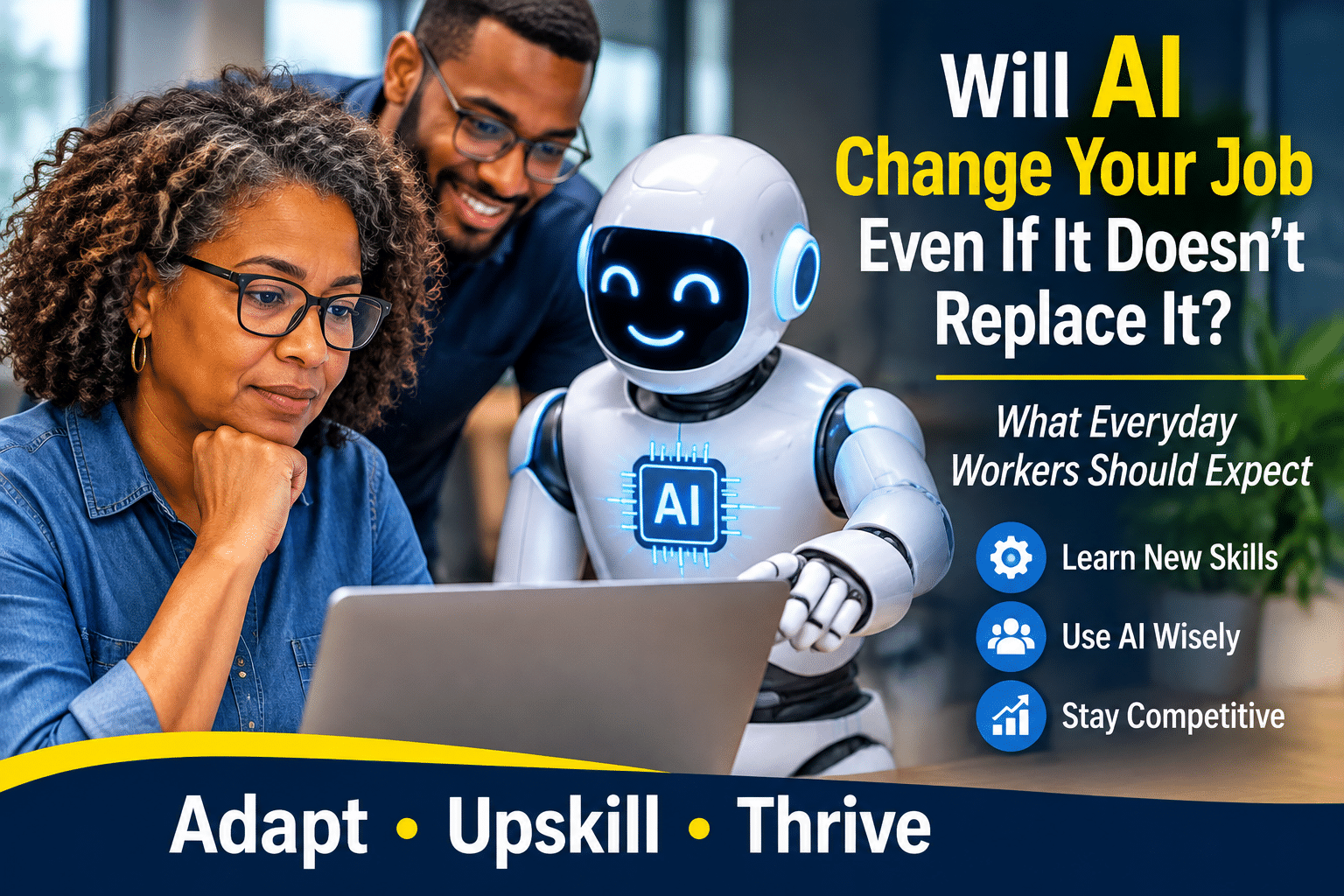

Will AI Change Your Job Even If It Doesn’t Replace It? What Everyday Workers Should Expect

Artificial intelligence may not replace your job, but it could change how you work. Discover why adaptability, new skills, and human judgment matter more than ever.

By Florita Bell Griffin, Ph.D. | Houston, TX | October 20, 2026

Much of the public discussion about artificial intelligence and employment begins with one frightening question: Will AI take my job? It is understandable that workers would worry about that possibility. New technology has always raised concerns about which kinds of work will disappear. Yet for millions of people, a more immediate question may be more useful: How will AI change the job I already have?

Technology has changed work repeatedly without eliminating every profession it touched. Office workers once prepared letters on typewriters and stored records in filing cabinets. Accountants performed calculations that spreadsheets now complete instantly. Airline tickets were once written by hand. Stores relied on paper inventories. Mechanics worked without computerized diagnostic systems. Architects drew plans manually. Doctors depended on paper medical files. Those occupations did not all disappear when computers arrived, but the way people performed them changed dramatically.

Artificial intelligence is beginning another transformation. An administrative employee may use AI to draft routine correspondence, organize meeting notes, summarize a long document, or prepare a first version of a report. A salesperson may use it to prepare follow-up messages or organize information about customers. A teacher may use it to develop sample questions or create explanations for students at different reading levels. A small-business owner may use AI to create promotional ideas, organize expenses, write product descriptions, or prepare customer communications.

The important point is that many of these examples involve tasks rather than entire jobs. A job is usually a collection of responsibilities. Some are repetitive, some require judgment, some depend on experience, and others depend on relationships. AI may become very good at one portion of a job without being capable of performing everything the worker does.

A nurse, for example, spends time documenting information, reviewing records, communicating with patients, observing physical conditions, coordinating care, responding to unexpected situations, and exercising professional judgment. AI might help summarize records or reduce paperwork, but that does not make the entire role of the nurse disappear. A construction professional may use automated estimating tools, but someone still has to understand the building, conditions, materials, workers, and customer. A teacher may use AI to help prepare a lesson, but the technology does not replace the human relationship between teacher and student.

In many occupations, the human part of the job may become more valuable as routine preparation becomes automated. If AI produces the first draft, someone must know whether the draft is correct. If it summarizes a customer complaint, someone must decide how to respond. If it analyzes a set of numbers, someone must understand whether the conclusion makes sense. If it recommends an action, someone must take responsibility for the consequences.

This creates an interesting possibility. Expertise may become more important rather than less important. An experienced accountant is more likely to recognize when an AI-generated financial analysis contains something unusual. A mechanic understands whether a suggested diagnosis makes sense given what the vehicle is actually doing. An attorney can recognize when a legal summary leaves out a critical issue. A teacher knows when an explanation is technically correct but unsuitable for a particular group of students. People who know their work well are in a stronger position to use AI because they can evaluate what the system produces. Someone with little understanding of a subject may be impressed by a polished answer and fail to notice that it is wrong.

Communication skills may also become increasingly valuable. AI can generate words, but workplaces still depend on trust, negotiation, persuasion, leadership, empathy, and judgment. A machine can draft an email to an unhappy customer, but it does not necessarily understand the history of the relationship. It can suggest how to handle a disagreement between employees, but a good manager still needs to listen to both people and understand what is happening beyond the written facts.

Workers who use their hands will encounter AI as well. Mechanics increasingly work with computerized diagnostic information. Farmers can use technology to analyze soil, crops, weather, and equipment. Construction companies can use AI-assisted tools for scheduling and estimating. Manufacturing workers may operate increasingly intelligent equipment. Electricians, technicians, and repair professionals may use systems that help identify problems before they begin work. This is important because the discussion about AI sometimes creates the impression that only office workers need to pay attention. In reality, artificial intelligence is likely to reach almost every major industry in some form.

Workers should begin observing which parts of their jobs are repetitive, predictable, or heavily based on processing information. Those are often the types of tasks that new technology affects first. If someone spends several hours each week transferring information from one document to another, summarizing routine reports, scheduling standard activities, or producing nearly identical communications, AI may eventually reduce the time required. That does not automatically mean the worker becomes unnecessary. It may mean the employer expects that person to accomplish more, focus on higher-level responsibilities, or develop new skills.

This is why waiting until an employer announces an AI transition may not be the best approach. Workers can begin learning now. They do not need to become computer programmers. They can explore tools related to their profession, experiment with low-risk tasks, and learn how to evaluate AI output. Someone who understands both the occupation and the new technology may have an advantage.

Young workers should think about this as they plan careers. Instead of simply asking which jobs AI cannot perform, they might ask which human abilities will remain valuable even as technology improves. Critical thinking, communication, leadership, creativity, practical experience, ethical judgment, relationship-building, adaptability, and deep subject knowledge are likely to remain important because they help people decide what should be done rather than merely complete a standard task.

There will undoubtedly be disruption. Some jobs will shrink. Certain tasks that once required many employees may require fewer. New occupations will emerge, and some familiar occupations will change substantially. The transition may be uncomfortable in some industries. Pretending otherwise would not help workers prepare.

At the same time, history shows that people repeatedly adapt to new tools. Few office workers today would want to give up email and return to carbon copies, filing cabinets, and typewritten correspondence. Few accountants would abandon spreadsheets. Few architects would insist on producing every drawing by hand. Tools that once seemed threatening often become ordinary parts of the profession.

AI may follow a similar path. The strongest position may belong to workers who neither fear the technology nor trust it blindly. They will learn how to use it, understand its limitations, and remain better at their profession because the technology handles some of the work that used to consume their time.

The future of employment may therefore be less about humans competing directly against machines and more about people learning how to work intelligently alongside them. AI may change your job even if it never replaces you. Understanding that distinction is one of the best ways to prepare for what comes next.

© 2026 Truth Seekers Journal. Published with permission from the author. All rights reserved.

Related articles:

Your Children Are Growing Up With AI: What Parents and Grandparents Need to Understand

What Happens When Your Car Starts Thinking for You? AI, Driving, and the Road Ahead

Who Owns What AI Creates? Your Photos, Your Voice, Your Writing, and the New Question of Digital Ownership

What Happens When AI Becomes Part of Healthcare? What Patients Should Know Before the Machine Helps Make the Decision

AI Can Save You Time, but Can It Make You Smarter?

Living With AI: How It Is Changing Work, Family, and Community

When Systems Forget Who They Were Built For     

Why Familiarity Is Not the Same as Understanding 

What is AutoLore?

Truth Seekers Journal thrives because of readers like you. Join us in sustaining independent voices.

Your Children Are Growing Up With AI: What Parents and Grandparents Need to Understand

As artificial intelligence reshapes childhood, parents and grandparents must help children balance learning, creativity, privacy, critical thinking, and healthy relationships with technology and others.

By Florita Bell Griffin, Ph.D. | Houston, TX | October 13, 2026

Children growing up today may never remember a world without artificial intelligence. They can already ask AI to explain homework, create pictures, write stories, answer questions, suggest games, translate languages, produce music, and carry on conversations. For adults who grew up with encyclopedias, libraries, handwritten school reports, and early search engines, the change can be difficult to fully appreciate. For a child, asking a machine for an immediate personalized answer may soon feel as ordinary as asking Google does today.

This creates extraordinary educational possibilities. A child struggling with fractions can ask for the idea to be explained in another way. A student who does not understand a paragraph in a textbook can request a simpler explanation. A young person curious about dinosaurs, astronomy, African history, architecture, agriculture, music, or robotics can continue asking questions as long as curiosity lasts. AI can respond without embarrassment, impatience, or the pressure some children feel when they are afraid of asking what they think is a “stupid” question.

For students with different learning needs, this can be especially valuable. One child may understand a concept best through an example. Another may need a step-by-step explanation. Someone learning English may want unfamiliar words translated. A student with reading difficulties may benefit from a simpler version of complicated material. When used thoughtfully, AI can provide a level of individual assistance that teachers and parents may not always have time to provide immediately.

The concern begins when assistance replaces learning. A child can now ask AI to write an essay, solve a homework assignment, answer questions, create a book report, or prepare a presentation. The work may look excellent even though the student has learned very little. A beautifully written essay is not evidence that the student understands how to develop an idea, organize an argument, examine evidence, or express an original thought.

Parents and grandparents therefore need to help children understand the difference between using AI to learn and using AI to escape learning. Asking, “Can you explain this math problem another way?” supports understanding. Asking, “Give me the answer so I can turn it in,” usually does not. Asking for feedback on a paragraph the student wrote can improve writing. Asking AI to write the entire assignment may prevent the child from developing the skill the assignment was intended to teach. The technology is the same. The purpose makes the difference.

Children also need to know that AI can be wrong. This may be one of the most important lessons adults can teach. AI often communicates in polished, confident language. A young person may naturally assume that an answer presented so clearly must be correct. Yet AI can misunderstand a question, provide outdated information, invent details, or state something inaccurately.

Adults can turn these mistakes into lessons. Ask a child to verify an AI answer using a textbook, reliable website, or another trustworthy source. Ask, “How do we know this is true?” Encourage the child to identify where the information came from. This develops a habit of verification that will be useful far beyond AI.

Children also need to understand that not everything online represents a real person or real event. AI-generated images, voices, videos, influencers, and social-media accounts are becoming more convincing. A child may encounter a realistic image of something that never happened or communicate with an account operated partly or entirely by software. Media literacy now requires more than knowing that photographs can be edited. Young people must understand that complete digital realities can be manufactured.

Privacy deserves equal attention. Children and teenagers may speak casually with AI because conversation feels personal. They may share their names, schools, locations, family details, fears, friendships, or personal problems without thinking about how digital information is handled. Parents should teach children that an AI conversation is still an interaction with a computer system. Personal information deserves the same care it would receive elsewhere online.

The issue becomes more complicated with AI companions. Some systems are designed to converse over long periods, respond emotionally, remember preferences, and behave like supportive friends. A young person who feels lonely or misunderstood may form a strong attachment to such a system. The interaction may provide comfort, but the child should understand what the relationship actually is.

An AI system can simulate interest and empathy through language. It does not experience friendship as another human being does. It does not share a childhood, have feelings, carry responsibility for the child’s welfare, or participate in the real community surrounding that young person. Children should not be taught that every emotional response generated by a machine represents an emotional experience inside the machine.

This does not mean parents need to prohibit every AI tool. Complete prohibition may leave children less prepared for technology they will encounter throughout education, employment, and adult life. Guided use is likely to be more effective. Parents and grandparents can explore AI with children, ask questions together, compare answers, and discuss what the system does well and where it fails.

Adults can also encourage children to use AI creatively without allowing it to consume creativity. A child might write a story first and then ask AI for ideas about how to improve it. Someone interested in art can create original drawings and also experiment with image-generation tools. A student planning a science project can brainstorm with AI but still design and understand the project independently.

Children should continue having experiences that do not involve intelligent assistance. They should read books without immediately requesting summaries, solve problems before asking for answers, draw pictures from imagination, play outdoors, talk with other people, build things, make mistakes, become bored, and figure out what to do next. Boredom itself can be productive because it forces the mind to invent.

The ability to work through frustration is also important. Learning often involves moments when the answer is not immediately available. If AI removes every difficult step, children may lose opportunities to develop persistence. There is value in struggling with a problem for a while before receiving help.

Schools and families will continue debating appropriate rules, but one principle can remain simple: children should know what they themselves are capable of doing. If AI completes every difficult intellectual task, a student may receive good grades without developing confidence in his or her own abilities.

Parents and grandparents have an important role because AI literacy is not merely a school subject. It involves values, judgment, privacy, honesty, relationships, and understanding when technology should be used at all.

The children growing up today will likely interact with increasingly capable artificial intelligence throughout their lives. Knowing how to operate those systems will probably become easy. Knowing when to question them, when to verify them, when to turn them off, and when another human being matters more may prove much more important.

We are not simply teaching children how to use a new technology. We are helping them decide what kind of relationship they will have with intelligent machines. If adults teach curiosity without dependence, openness without gullibility, and technological skill without surrendering independent thought, AI can become a powerful educational tool while the child remains firmly at the center of the learning.

© 2026 Truth Seekers Journal. Published with permission from the author. All rights reserved.

Related articles:

What Happens When Your Car Starts Thinking for You? AI, Driving, and the Road Ahead

Who Owns What AI Creates? Your Photos, Your Voice, Your Writing, and the New Question of Digital Ownership

What Happens When AI Becomes Part of Healthcare? What Patients Should Know Before the Machine Helps Make the Decision

AI Can Save You Time, but Can It Make You Smarter?

Living With AI: How It Is Changing Work, Family, and Community

When Systems Forget Who They Were Built For     

Why Familiarity Is Not the Same as Understanding 

What is AutoLore?

Truth Seekers Journal thrives because of readers like you. Join us in sustaining independent voices.
What Happens When Your Car Starts Thinking for You? AI, Driving, and the Road Ahead

Explore how AI is transforming driving with smart assistance, predictive safety, navigation, diagnostics, and autonomous technology, while keeping drivers informed, engaged, and responsible.

By Florita Bell Griffin, Ph.D. | Houston, TX | October 6, 2026

For most of automotive history, the relationship between a person and a car was straightforward. The driver steered, accelerated, braked, watched the road, and made nearly every important decision. The vehicle responded mechanically to human commands. Modern vehicles are changing that relationship because computers increasingly watch the road alongside the driver and, in some situations, intervene before the person does.

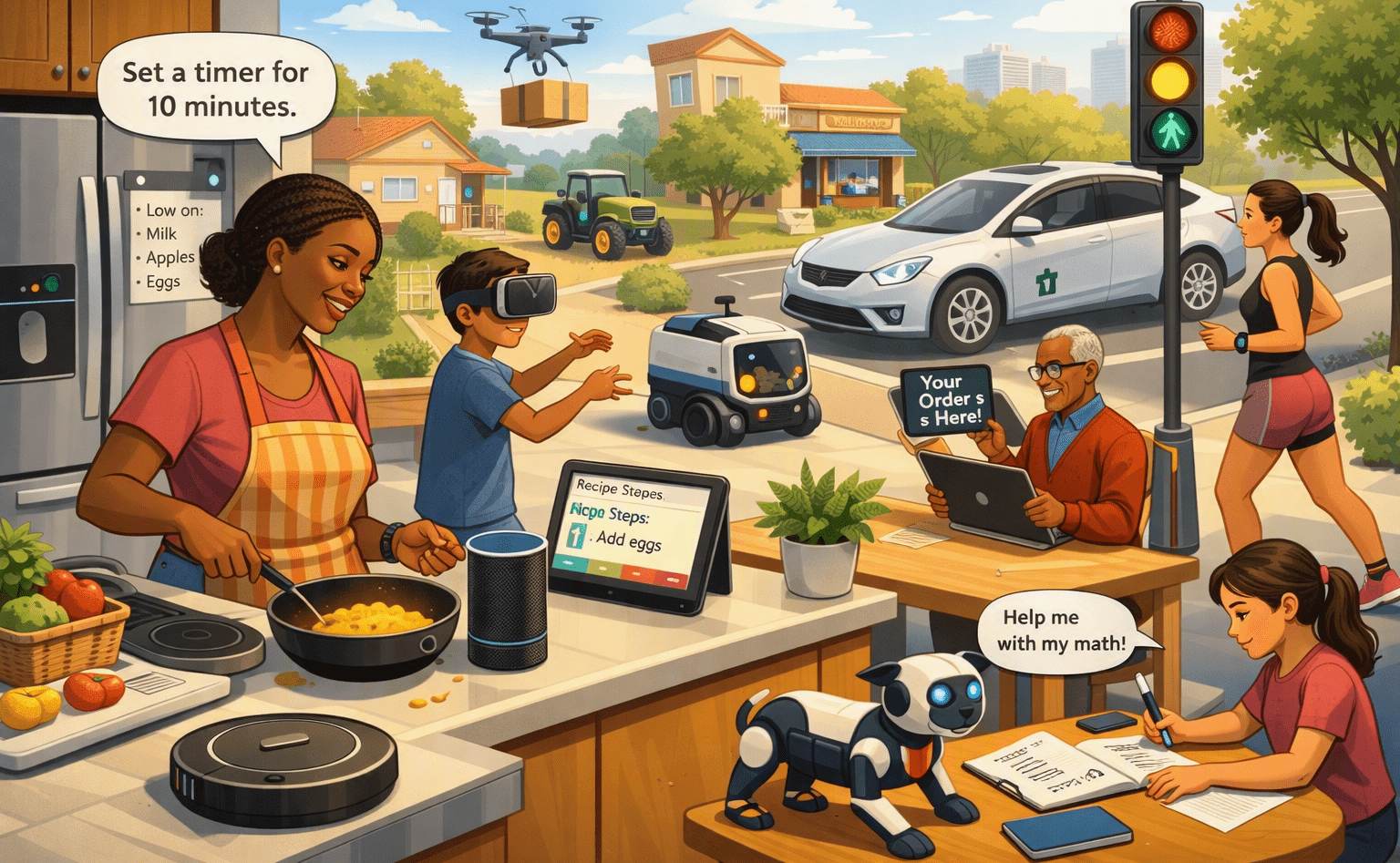
Many drivers already own vehicles with technology that would have sounded futuristic a generation ago. A car may warn that another vehicle is in the blind spot, apply the brakes when a collision appears likely, maintain a selected distance behind traffic, help keep the vehicle centered in a lane, recognize road signs, monitor tire pressure, display a camera view of the surroundings, or guide the driver into a parking space. None of these features requires a humanoid robot sitting behind the steering wheel. Artificial intelligence in transportation often appears quietly through sensors, cameras, software, and automated assistance.

The distinction between driver assistance and self-driving is important because the terms are often blurred in advertising and everyday conversation. The National Highway Traffic Safety Administration says that the driver remains responsible at the lower levels of automation used in consumer vehicles today. Level 1 systems may assist with either steering or acceleration and braking, while Level 2 systems can assist with both at the same time, but the human driver is still expected to remain fully engaged and attentive.

That means a vehicle capable of maintaining speed, following traffic, and helping steer on the highway is not automatically a fully autonomous car. The technology can reduce workload, particularly during long highway drives, but the person behind the wheel remains responsible for monitoring conditions and being prepared to respond. The difference matters because a driver who misunderstands what the system can do may stop paying enough attention precisely when attention is still required.

Automatic emergency braking provides a good example of how these technologies can be valuable without replacing the driver. Sensors may detect that the vehicle is closing rapidly on an obstacle and apply the brakes when the driver has not reacted quickly enough. The system may reduce the severity of a collision or help avoid one altogether. Blind-spot monitoring can warn that another vehicle is difficult to see, while rear cross-traffic warnings can alert a driver backing out of a parking space.

These features are essentially extra sets of electronic eyes, but electronic eyes are not perfect. Cameras can be affected by darkness, glare, weather, dirt, road markings, or unusual conditions. Sensors can misunderstand an environment, and software works within the limits established by its design. Human beings also make mistakes, of course, which is one reason driver-assistance technology exists. The safest relationship may be one in which the machine and the driver support one another rather than either being treated as infallible.

Navigation has already demonstrated how quickly people can become comfortable allowing technology to influence driving decisions. Few drivers now think twice about following a route suggested by a phone or dashboard system. Traffic data can identify congestion, accidents, road closures, and faster alternatives in real time. AI can help estimate arrival times and continually adjust the route as conditions change.

Yet anyone who has used navigation for long enough has also experienced its limitations. The system may direct a driver toward an inconvenient entrance, recommend a route through an uncomfortable neighborhood, fail to understand temporary construction, or insist on a turn that local knowledge says makes no sense. Most people eventually learn the right relationship: appreciate the assistance but remain willing to disagree.

The same lesson applies to more advanced vehicle intelligence. Drivers need to understand what their particular car can actually do rather than relying on a general impression created by the name of the feature. Terms such as “pilot,” “assist,” or other branded language can sound more capable than the underlying technology. Reading the owner’s manual may not be exciting, but understanding when a system works, when it may disengage, and what the driver must continue monitoring is part of safely using the vehicle.

AI is also changing what happens before a car breaks down. Modern vehicles generate enormous amounts of diagnostic information. Sensors monitor engines, batteries, emissions, tire pressure, electrical systems, and other components. Increasingly intelligent diagnostic tools can help technicians identify patterns and narrow down likely problems faster than older methods allowed.

For electric vehicles, software plays an especially central role because battery management, charging, energy efficiency, temperature control, and range prediction depend heavily on computerized systems. The vehicle may learn from driving patterns and adjust estimates based on conditions. Over time, cars may become better at predicting maintenance needs before a component fails, giving owners an opportunity to address problems earlier.

Parking is another area where the relationship between driver and machine is changing. Cameras now create overhead views that appear to look down on the vehicle from above. Parking sensors measure distance from nearby objects, while automated systems may steer into a space with limited input from the driver. Features that once appeared only on expensive luxury vehicles have gradually moved into more ordinary models.

The longer-term future goes further. Higher levels of automated driving are designed for situations in which the system performs more of the driving task, eventually reaching the point where occupants may function as passengers rather than drivers. NHTSA currently distinguishes these advanced levels from the driver-assistance technology available in ordinary consumer vehicles and notes that full automation is not currently something consumers can simply purchase for unrestricted use on all roads.

If truly autonomous vehicles become common, the consequences could extend far beyond convenience. Older adults who no longer drive might retain greater mobility. People with certain disabilities could gain new transportation independence. Long-distance freight could change, parking needs might decline in some places, and cities could eventually reconsider how roads, curbs, garages, and transportation systems are designed.

There are also everyday questions about responsibility. If a vehicle assists with steering and the driver stops paying attention, who is responsible when something goes wrong? What happens when software behaves differently after an update? How should drivers be told when a feature changes? These questions become increasingly important as vehicles begin to resemble computers on wheels.

Privacy enters the discussion as well. Connected vehicles can generate information about location, driving behavior, vehicle performance, and use of onboard services. Drivers should become more accustomed to asking what information a vehicle collects, which services receive it, and what controls are available. Buying a car increasingly involves accepting a digital relationship with the manufacturer as well as purchasing a physical machine.

The most important point for everyday drivers is that artificial intelligence in cars is not arriving all at once. It is arriving one feature at a time. A warning light becomes a predictive alert, cruise control becomes adaptive, a rearview mirror is supplemented by cameras, and steering assistance becomes more sophisticated. Each improvement feels small until we look back and realize how much of the driving experience has changed.

Drivers do not need to fear these developments, and they do not need to pretend the technology is more capable than it is. The wisest approach is to understand exactly what the vehicle is doing and remain engaged wherever human responsibility remains necessary.

Cars are becoming more intelligent, but intelligence in a machine does not automatically eliminate the need for intelligence from the person using it. The safest future may depend on drivers who understand both sides of that relationship and know when to accept assistance, when to remain alert, and when to take control.

© 2026 Truth Seekers Journal. Published with permission from the author. All rights reserved.

Related articles:

Who Owns What AI Creates? Your Photos, Your Voice, Your Writing, and the New Question of Digital Ownership

What Happens When AI Becomes Part of Healthcare? What Patients Should Know Before the Machine Helps Make the Decision

AI Can Save You Time, but Can It Make You Smarter?

Living With AI: How It Is Changing Work, Family, and Community

When Systems Forget Who They Were Built For     

Why Familiarity Is Not the Same as Understanding 

What is AutoLore?

Truth Seekers Journal thrives because of readers like you. Join us in sustaining independent voices.
Who Owns What AI Creates? Your Photos, Your Voice, Your Writing, and the New Question of Digital Ownership

What Happens When AI Becomes Part of Healthcare? What Patients Should Know Before the Machine Helps Make the Decision

By Florita Bell Griffin, Ph.D. | Houston, TX | September 29, 2026

For most of modern creative history, people had a reasonably intuitive understanding of authorship. A writer wrote a book, a photographer took a photograph, a musician composed a song, and an artist painted a picture. Questions of ownership could still become complicated, particularly when employers, publishers, contracts, or collaborations were involved, but the connection between human creator and creative work was usually easy to see.

Generative artificial intelligence has made that connection far more complicated. A person can now type a few sentences and receive an original-looking image, song, essay, voice recording, video, logo, or design. The result may never have existed before, yet the person who requested it may not have physically drawn, photographed, performed, or written most of what appears. This raises a simple-sounding question with a surprisingly complicated answer: Who owns it?

In the United States, copyright protection has traditionally been based on human authorship. The U.S. Copyright Office stated in its 2025 report on AI and copyrightability that material produced by generative AI can receive copyright protection when sufficient human-authored expression is involved, but purely AI-generated material is not protected merely because a person supplied prompts. The Office also explained that using AI as a tool does not automatically prevent a larger human-created work from qualifying for copyright.

For everyday users, the easiest way to understand this is to think about creative control. If someone asks an AI system to “create a beautiful sunset over the ocean” and simply accepts the first image, the human contribution may be limited. If a person creates original material, repeatedly modifies elements, combines AI-generated portions with substantial human work, edits the composition, and makes creative choices about the final result, the analysis becomes different.

The exact legal outcome can depend on the particular work and circumstances, so people creating valuable commercial material should seek appropriate legal advice. The broader principle, however, is useful for everyone: asking a machine to make something and personally authoring the creative expression are not necessarily the same thing.

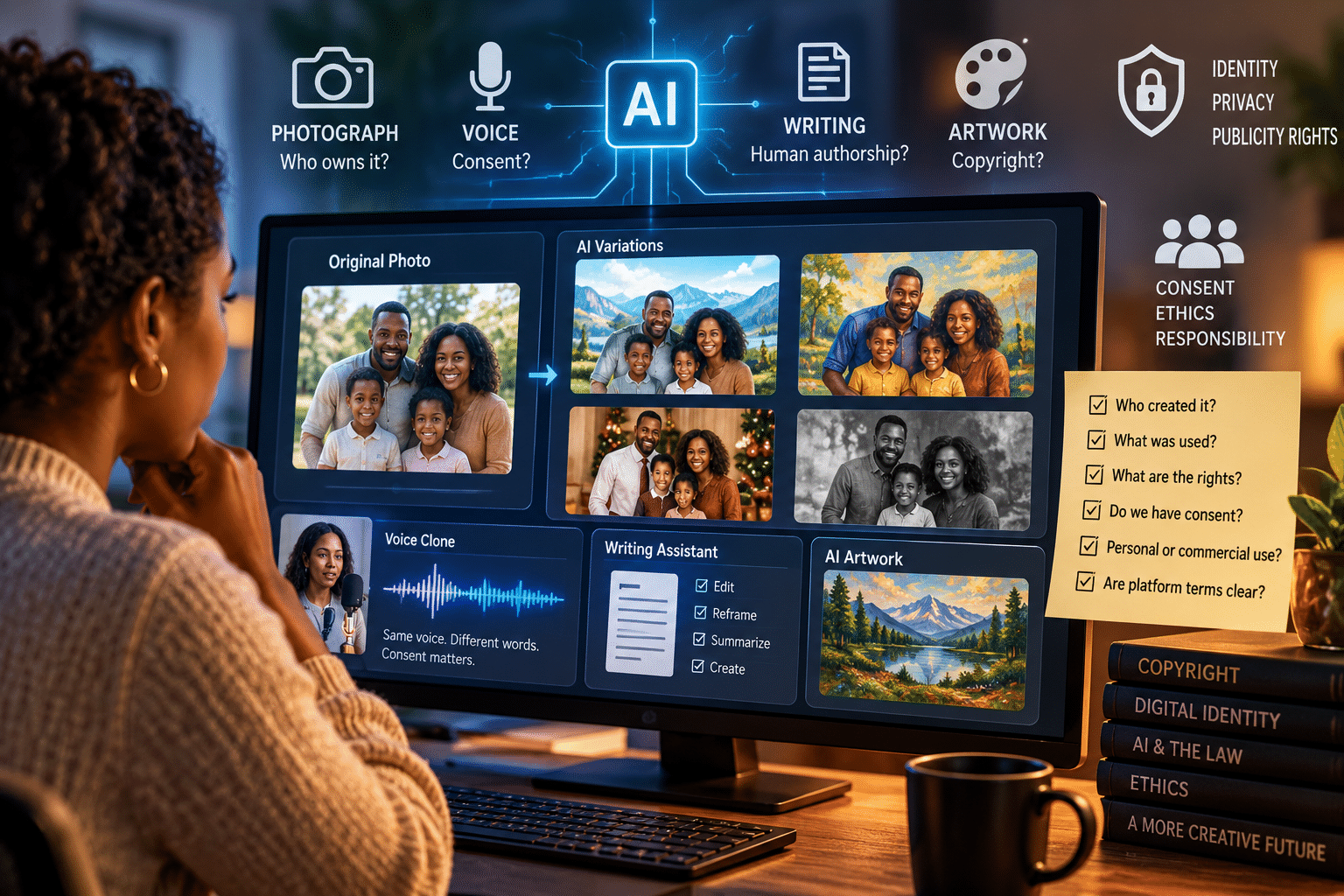
The issue becomes even more interesting with photography. Suppose someone uploads a family photograph to an AI system and asks it to change the background, improve the lighting, alter clothing, or create a painting based on the image. The original photograph may already have a human photographer whose copyright exists independently of the AI-generated version.

People often assume that because they appear in a photograph, they automatically own the photograph. Copyright generally belongs initially to the photographer unless some other legal arrangement changes that result. This is one reason professional photography agreements often specify what the customer may reproduce, publish, or distribute.

Voice raises another set of questions because a voice is not simply a piece of creative content. It is part of a person’s identity. AI voice-cloning technology can reproduce the sound of someone speaking words that person never said. This creates issues involving consent, impersonation, privacy, publicity rights, fraud, contracts, and other laws that go beyond ordinary copyright.

The U.S. Copyright Office devoted the first part of its AI report to digital replicas and recommended federal legislation addressing unauthorized replicas of a person’s voice or appearance. That demonstrates how quickly the idea of digital identity is becoming a serious legal and social issue.

Everyday people should begin thinking of their voices as digital assets. A recording posted publicly can potentially become material from which technology learns vocal characteristics. The same is true of video. People who once thought nothing of posting long recordings of themselves online may increasingly want to consider how those recordings could be reused.

This is especially relevant to performers, speakers, teachers, musicians, influencers, actors, executives, and anyone whose voice or appearance has professional value. A contract allowing a company to use a recorded performance may need to address whether the material can also be used to generate future synthetic performances.

Writing creates another interesting boundary. Many people now use AI to improve emails, articles, reports, books, advertising copy, and social-media posts. If the person begins with original ideas and writing and uses AI mainly for editing, restructuring, or assistance, the human creative contribution remains clear. If the machine generates nearly everything and the user merely accepts it, the situation becomes less straightforward.

The safest practice for creators who want to maintain a strong record of human authorship is to preserve their own contribution. Keep drafts, notes, outlines, revisions, source materials, photographs, sketches, or other evidence showing how the work developed. These records can demonstrate that AI functioned as a tool within a broader human creative process rather than serving as the only source of expression.

Ownership also depends on the terms of the AI service being used. A platform may allow users broad rights to use outputs while imposing other conditions through its terms of service. Those terms can change, and commercial users should understand them rather than assuming every AI service operates under the same rules.

Businesses face additional concerns when employees create material with AI. A worker may use a generative system to create a company logo, advertisement, training manual, presentation, or design. The company should understand what tool was used, what source material was entered, and what rights exist in the resulting work.

There is also the question of what was used to train generative AI systems in the first place. Writers, artists, publishers, photographers, and other creators have raised significant questions about whether copyrighted works can be used for AI training and under what circumstances. The Copyright Office has separately examined those issues, which remain part of an evolving legal and policy landscape.

For ordinary users, the important point is that “AI made it” does not answer every ownership question. One must still ask what human material went in, who contributed creative expression, what platform terms apply, whether another person’s image or voice was used, and whether the final work will be used privately or commercially.

Consent may become as important as ownership. A person might legally possess a photograph of a friend but still create serious ethical problems by using that photograph to generate embarrassing or deceptive material. The ability to create something does not automatically create the right to use another person’s identity however we choose.

Families will face these questions too. Parents may use AI to create imaginative pictures of children. Relatives may animate old family photographs or recreate the voice of someone who has died. These uses can be meaningful and emotionally powerful, but they also introduce questions about dignity, consent, memory, and the line between preserving history and manufacturing events that never happened.

Technology has made creation easier than ever before, but easier creation requires more thoughtful decisions about authorship and responsibility. We are entering a period in which people may possess thousands of digital objects that were partly created by humans and partly created by machines. The most useful question may therefore be larger than “Who owns this?” We may also need to ask who authored it, who consented to it, what source material contributed to it, what rights were granted, and how honestly the final work is being presented.

Artificial intelligence has opened extraordinary creative possibilities to people who may never have considered themselves artists, writers, musicians, or designers. That expansion of creativity can be exciting. It also means that ordinary people now encounter questions once reserved for publishers, lawyers, studios, and professional creators.

In the AI era, creativity is becoming easier to produce while authorship is becoming harder to define. Understanding that difference will be increasingly important for anyone who wants to create, publish, sell, share, or protect digital work.

© 2026 Truth Seekers Journal. Published with permission from the author. All rights reserved.

Related articles:

What Happens When AI Becomes Part of Healthcare? What Patients Should Know Before the Machine Helps Make the Decision

AI Can Save You Time, but Can It Make You Smarter?

Living With AI: How It Is Changing Work, Family, and Community

When Systems Forget Who They Were Built For     

Why Familiarity Is Not the Same as Understanding 

What is AutoLore?

Truth Seekers Journal thrives because of readers like you. Join us in sustaining independent voices.

What Happens When AI Becomes Part of Healthcare? What Patients Should Know Before the Machine Helps Make the Decision

Discover expert insights, practical tips, and trusted solutions designed to boost performance, save time, and deliver lasting results for individuals and businesses worldwide today online

By Florita Bell Griffin, Ph.D. | Houston, TX | September 22, 2026

Most patients do not walk into a doctor’s office expecting to meet artificial intelligence. They expect to see a physician, nurse, technician, receptionist, or other healthcare professional. Yet AI may already be involved in parts of the healthcare experience without appearing as a separate machine at all.

Artificial intelligence can assist with medical imaging, record review, risk assessment, scheduling, documentation, monitoring, and other tasks. Software may help identify patterns in scans, organize large amounts of clinical information, or flag something that deserves a professional’s attention. The FDA maintains a public list of AI-enabled medical devices that have met applicable premarket requirements, illustrating that AI is already part of regulated medical technology in the United States.

For patients, this can be encouraging. Healthcare produces enormous amounts of information, and no human being can process every data point instantly. A computer system capable of examining images or recognizing patterns quickly may help clinicians notice something sooner, reduce repetitive work, or bring useful information together before a decision is made.

Consider medical imaging. Radiologists may examine large numbers of X-rays, CT scans, MRIs, mammograms, and other images. AI-assisted systems can help identify patterns or areas that may deserve closer examination. The purpose is not necessarily to remove the radiologist from the process but to provide another analytical tool.

The distinction between assisting and deciding is important. Patients should not imagine healthcare AI as one giant machine that determines whether someone is sick. Many systems perform narrow tasks. One may analyze a particular kind of image, while another helps organize records or predict a specific risk.

AI may also help reduce a less visible burden in medicine: documentation. Doctors and nurses spend significant time recording visits, completing forms, reviewing histories, and navigating electronic medical records. Generative AI tools are increasingly being explored for summarizing conversations and preparing clinical notes, potentially allowing healthcare professionals to spend more of the visit interacting with patients rather than typing.

That could improve the patient experience if it works well. A physician who can maintain eye contact and listen carefully instead of focusing on a computer screen may have a better conversation with the person seeking care. At the same time, a generated medical note must accurately reflect what occurred. A polished summary that leaves out a symptom or incorrectly records a medication could create problems later.

Patients already have a practical tool for dealing with this possibility: read their medical records when they are available. If the summary of a visit contains an error, ask for it to be corrected. This was good advice before AI entered healthcare and becomes even more important as documentation grows more automated.

Personal health devices are another part of the story. Smartwatches and other consumer technologies can collect information about heart rate, movement, sleep, exercise, and other patterns. Some people may discover useful changes and bring them to a doctor’s attention. Others may become anxious about numbers they do not fully understand.

More data is not automatically the same as better health. A device may produce information without understanding the full medical context. Patients should distinguish between wellness information, a medical-device function, and an actual clinical diagnosis.

AI chatbots have added another layer because people increasingly ask them medical questions before speaking with a healthcare professional. Someone may describe a symptom, ask about a laboratory result, or request an explanation of a medical term. This can be enormously helpful when the goal is understanding.

The risk appears when explanation becomes diagnosis or when general information is treated as personalized medical advice. An AI system cannot necessarily examine the patient, feel an abdomen, listen to breathing, observe subtle physical behavior, confirm every medication, or know the entire history unless that information has been reliably provided.

A useful approach is to use AI to become better prepared for medical care. Ask it to explain unfamiliar vocabulary in plain English. Use it to create a list of questions for the doctor. Ask what information might be useful to bring to an appointment. After a visit, use it to help organize instructions while verifying anything important against the official medical record.

Privacy is especially important with health information. A person may be comfortable telling an AI system intimate medical details because the conversation feels private and nonjudgmental. Different services, however, may handle data differently, and not every consumer AI tool operates under the same privacy rules as a physician’s office or hospital.

Before uploading complete medical records, users should understand the service they are using and consider whether names, addresses, dates of birth, identification numbers, and other unnecessary details can be removed. The AI may need the laboratory value to explain what it means, but it usually does not need the patient’s Social Security number.

Patients should also become comfortable asking whether AI played a role in important medical decisions. The question does not need to be confrontational. Someone might simply ask, “Was software used to help interpret this scan?” or “Was this recommendation generated or assisted by an automated system?” Understanding the role of technology can help the patient understand the decision-making process.

The FDA has continued developing regulatory approaches for AI-enabled medical devices and, in August 2026, specifically sought public feedback about generative AI-enabled medical devices, including questions involving risk assessment, premarket evaluation, and monitoring after products reach the market. The fact that regulators are actively examining these systems reflects both their promise and their growing importance.

AI systems can also change over time. Traditional medical equipment may perform essentially the same function each time it is used. Software can be updated, and certain AI systems may be designed to evolve or be modified. This creates important questions about how changes are tested, documented, and monitored.

Patients do not need to understand software engineering to care about the answer. They simply need confidence that the tool influencing their healthcare has been appropriately evaluated and that qualified professionals remain responsible for how it is used.

Bias is another concern because medical data reflects real populations, and populations do not always receive equal care or appear equally in research datasets. An AI system trained on incomplete or unrepresentative information may perform differently across groups. Healthcare professionals and regulators therefore need to evaluate not just whether a system works on average but whether it works reliably for the kinds of patients who will actually depend on it.

The presence of AI does not automatically make a medical decision better or worse. A highly skilled clinician using a well-designed tool may make a better-informed decision. A poorly designed system used without sufficient oversight could create new problems.

The patient’s role remains important. Ask questions. Keep accurate medication lists. Review test results. Correct errors in the medical record. Seek another professional opinion when a major decision remains uncertain. AI does not eliminate any of these traditional forms of patient participation.

It may eventually strengthen them. A patient who once left an appointment confused by unfamiliar language can now receive an explanation in ordinary terms. Someone preparing for surgery can organize questions in advance. A caregiver managing information for an older relative can create a clearer timeline of appointments and instructions.

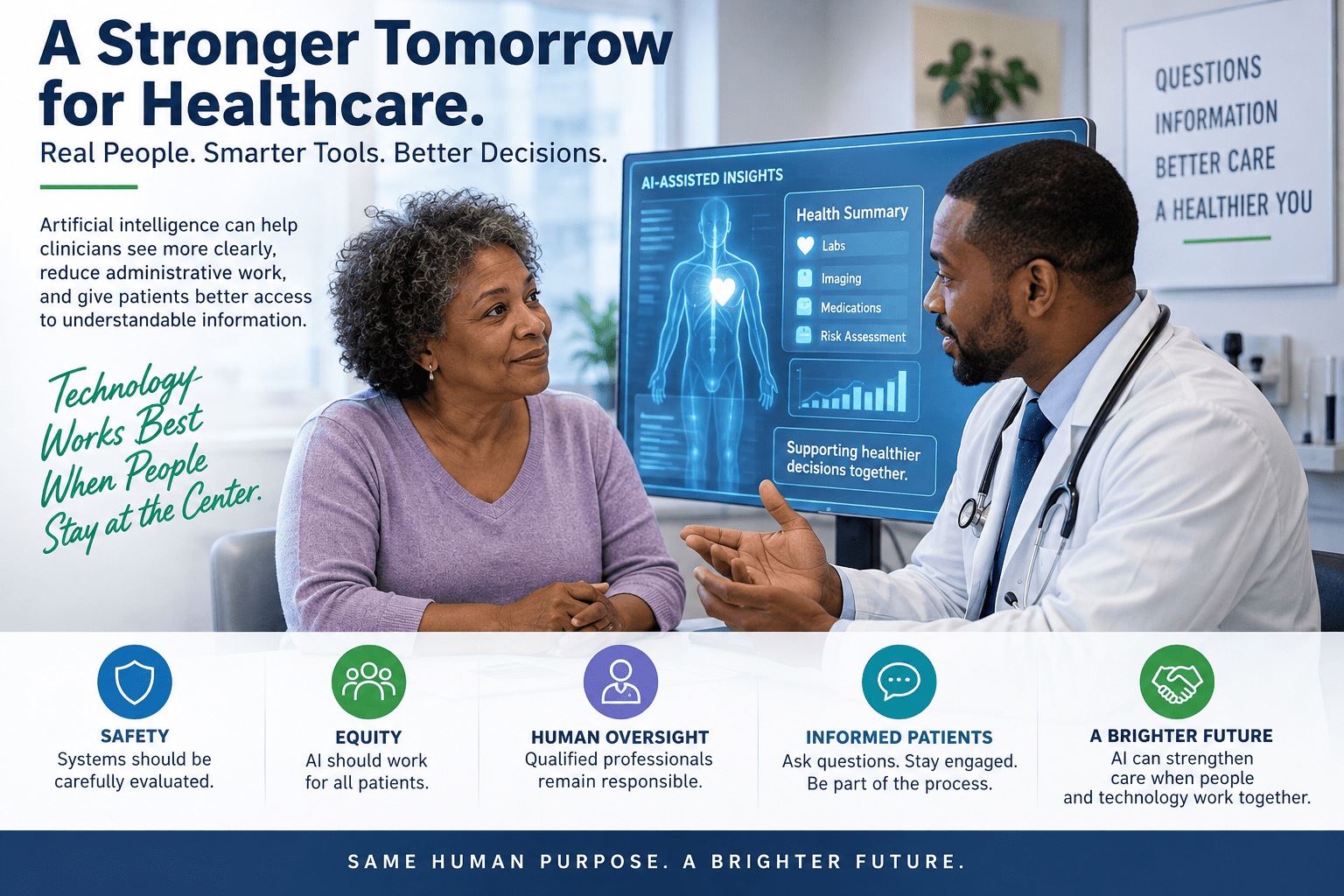
The best future for healthcare AI is not one in which machines quietly make decisions while patients simply accept them. It is one in which technology helps clinicians see more clearly, reduces unnecessary administrative work, gives patients better access to understandable information, and leaves responsibility where it belongs.

Medicine has always combined science with judgment. Artificial intelligence adds a powerful new source of analysis, but it does not change the basic truth that healthcare involves a real human being whose body, history, fears, goals, and circumstances cannot be reduced to a collection of data points.

Patients do not need to fear the machine entering healthcare, and they should not worship it either. They need to understand when it is present, what role it plays, and who remains responsible for the final decision. That knowledge can help ensure that artificial intelligence becomes a tool that strengthens medical care rather than something that quietly separates patients from the people caring for them.

© 2026 Truth Seekers Journal. Published with permission from the author. All rights reserved.

Related articles

Can You Trust What You See? Deepfakes, Altered Images, and the New Reality of Digital Evidence

Living With AI: How It Is Changing Work, Family, and Community

What Happens to Your Information After You Type It Into an AI Chatbot?

AI Can Save You Time, but Can It Make You Smarter?

Living With AI: How It Is Changing Work, Family, and Community

When Systems Forget Who They Were Built For     

Why Familiarity Is Not the Same as Understanding

What is AutoLore?

Truth Seekers Journal thrives because of readers like you. Join us in sustaining independent voices.

From AI Curiosity to Digital Mastery: Atlanta Entrepreneurs Put Artificial Intelligence to Work

Atlanta entrepreneurs move from AI curiosity to practical application through the Atlanta Business League’s Digital Mastery program, learning technology, strategy, security and business growth.

By Milton Kirby | Atlanta, GA | September 22, 2026

By the time a group of Atlanta-area entrepreneurs gathered at the Russell Innovation Center for Entrepreneurs on July 31, artificial intelligence was no longer simply something to ask questions.

It had become something they were expected to put to work.

For months, participants in the Atlanta Business League’s Digital Mastery program had worked through online visibility, email marketing, social media, automation, data management, cybersecurity, business expenses and artificial intelligence.

Now came the harder question: What were they going to do with it?

The final session was designed to bring the lessons together as participants developed 30-day, 90-day and year-long AI plans for their businesses.

It was the culmination of a 10-session program called “Digital Mastery for Small Business Growth: From Online Presence to AI-Powered Success,” sponsored by Comcast and taught by Dr. Kimberly N. West, founder of Magnum Opus Consulting and an Atlanta Business League board member.

Fifty-three people registered for the 2026 program, following more than 35 business owners and professionals who received certificates of completion in 2025.

Atlanta Business League President CEO Leona Barr Davenport, who attended most of the sessions, said the commitment required from the entrepreneurs was itself significant.

“These are entrepreneurs who, despite being busy, took the time to learn,” Davenport said.

She credited Comcast, West and the participants with making the experience “both valuable and enjoyable.”

The course promised practical instruction aimed at helping entrepreneurs strengthen their online presence, streamline operations and use digital tools and AI to improve visibility, automate workflows and increase revenue. Each session was structured around instruction, hands-on implementation, questions and real-world application.

But learning artificial intelligence turned out to involve considerably more than learning how to write a good prompt.

For some participants, it meant reconsidering how customers find their businesses. For others, it meant discovering where important company information was stored, who had access to it or how much money was disappearing each month into software subscriptions.

And for at least one participant, it began with a more basic question:

What does any of this have to do with running a newspaper?

Learning From Inside the Classroom

Disclosure is important here.

I was not an outside observer of Digital Mastery. I was a participant.

Comcast asked me to document the cohort’s journey in a feature for The Truth Seekers Journal. When I invited classmates to share their experiences, I told them the story would not be written “from the outside looking in,” but from “right here in the trenches” with them.

That gave me an unusual position from which to report the story.

Dr, Kimberly N. West 7-31-26 session – (Milton Kirby)

I was simultaneously learning the material and evaluating whether it had practical value for the newspaper I publish.

Halfway through the course, I wasn’t convinced.

During a May conversation with fellow participant Delphyne Lomax Taylor, we talked about having to go back and watch the Zoom sessions again to fully absorb the material.

“My intentions was to apply the class to the newspaper,” I told her, according to a recording of the conversation. “And so far not much has been covered that actually applies to the newspaper.”

I had asked West for at least “one nugget” each week that could specifically apply to a newspaper because I saw publishing as different from many of the other businesses represented in the class.

Taylor was wrestling with the material in her own way.

She was already using ChatGPT for practical business tasks. She described writing proposals and emails herself and then putting them into AI to have the language tightened. At one point, she said she began paying for ChatGPT after reaching a usage limit while trying to complete her work.

The conversation captured something that could easily be lost in all the excitement surrounding AI.

Using it is one thing.

Understanding how it fits into an actual business is another.

More Than ChatGPT

That distinction was central to West’s approach.

Her course did not treat AI as a stand-alone technology that business owners needed to bolt onto their companies.

In one session, West urged participants to think about technology they were already using. AI capabilities were increasingly appearing inside existing business software, she explained.

Delphyne Lomax Taylor 7-31-26 session (Milton Kirby)

“The question is not which shiny tool you should chase,” West said. Instead, businesses should ask whether they are using the AI capabilities already available inside their existing tools.

“Because that’s really where the work is actually happening.”

That approach matters at a time when entrepreneurs can be bombarded with new AI applications promising to write, design, automate, analyze or otherwise transform their businesses.

West’s advice was to begin with the business problem.

When one participant asked how many AI tools a business should use, West said there was no universal answer.

“What you need to do is you have to look at your business and look at what the business needs are and then find the tool or tools that are going to satisfy the needs of your business,” she said.

It was a less glamorous lesson than simply demonstrating the newest AI product.

But it may have been one of the course’s most useful.

Getting the House in Order

That became particularly apparent during the May 14 session.

West called it “Get Your House in Order.”

The subjects were money, data and security.

“This is not the sexiest module that we have,” West told the class. “It’s a little boring sometimes. But it is probably one of the most important modules that we will have.”

One exercise was what West called the “seven day disappearance test.”

Suppose the owner became completely unavailable for seven days.

What would break?

What would stall?

What would become confusing?

Participants were told to think about passwords, backups, systems, vendors, approvals, money, data, security and operations. Some said payroll or operational decisions could suffer. Others said their businesses could continue. Taylor said her business partner could step in, but if both were unavailable, most or all of the business could be affected.

Then West turned to data.

“Data is the asset that most business owners do not realize that they own,” she said.

Customer records. Contracts. Vendor records. Receipts. Reports. Standard operating procedures. Content libraries. Training materials.

“Data is business memory.”

For a newspaper publisher wondering how this course applied to journalism, that was one of those nuggets I had been asking for.

A newspaper’s memory is its reporting.

Recordings. Transcripts. Photographs. Source documents. Research. Contacts. Drafts. Published articles.

Lose control of those assets and AI is the least of the problem.

The session also pushed participants to examine recurring technology expenses and security practices. West encouraged them to know what they were paying for, whether tools were actually being used and whether critical accounts had backups, multifactor authentication and recovery plans.

Suzanne Forte, senior director of public relations for Comcast’s Big South Region, said business owners are confronting economic uncertainty, rising costs and a technology environment moving faster than many can track.

At the same time, they are increasingly expected to understand cybersecurity, digital operations and customer experience while still operating their businesses.

The cohort was intended to help entrepreneurs apply technology to customer engagement, operations and business decisions.

“Technology and digital skills help people connect, learn, work, and thrive,” Forte said in written responses to questions from The Truth Seekers Journal.

She said Comcast’s support was intended to help entrepreneurs “access tools and knowledge they can use to adapt, grow, and participate more fully in the digital economy.”

But Forte’s definition of success did not stop at completing a class or receiving a certificate.

“When participants apply what they learn, share those skills, and strengthen their businesses and networks, that demonstrates meaningful progress,” she said.

By that measure, the question becomes not what was taught during the 10 sessions, but what participants did afterward.

From Understanding to Execution

Dr. Patricia Kelly Marsh came to Digital Mastery with a considerable head start.

Marsh is a physician and CEO of Ask Me Your MD, Inc., or AMY MD. Her company was already using AI to support what she described as a scalable telechat care model.

She joined the program because she wanted a better understanding of available AI and digital tools and how they could be strategically applied to healthcare delivery, technology development and company growth.

For Marsh, one of the most significant changes involved digital visibility.

Before the course, she said, digital visibility seemed important but broad. The program helped her become more deliberate about brand awareness, online engagement and the company’s digital footprint.

Marsh reported that after applying lessons from the program, AMY MD experienced more than a 400% increase in engagement across its social media platforms. She also said website events per session increased and the site’s key-event rate nearly tripled.

Those results were reported by Marsh and were not independently verified by The Truth Seekers Journal.

She described the experience as taking her “from basic understanding to bold execution.”

The program, she said, gave her the tools and confidence to use AI and digital strategy to help grow and scale the company.

When the Person Outranks the Business

Yvonne Bryant Johnson found a different lesson.

Johnson said an AI and strategic branding exercise revealed that her own name had greater online visibility and recognition than her company, Bryant & Associates..

“That realization was both humbling and transformational,” Johnson wrote.

It made her reconsider the relationship between her personal brand, the company’s identity and her long-term business strategy.

Johnson said assignments that initially felt like homework became opportunities to sharpen her thinking about branding, search-engine optimization, visibility and trust.

She also praised West’s ability to turn complicated concepts into “practical tools and actionable frameworks.”

Johnson’s perspective comes with relevant context: she has longstanding ties to the Atlanta Business League. She described herself as a founding faculty member of ABL’s Take Your Business 2 the Next Level program and a past ABL board member.

Still, her experience illustrates one of the course’s broader lessons.

AI does not necessarily have to invent something new for a business.

Sometimes its value comes from revealing something about the business that was already there.

Owning the Audience

West also repeatedly pushed participants to distinguish between digital platforms they use and digital assets they own.

After a session devoted to email systems, she reminded participants that social media companies can come and go and algorithms can change.

An email list, however, belongs to the business.

“If you walked away understanding that one thing, Session 2 did its job,” West wrote afterward.

Another session dealt with finding where an audience actually lives online and using AI to create content that sounds like the business rather than like everyone else using the same technology.

For small businesses, those lessons can be easy to overlook amid fascination with generative AI.

The technology may be new.

The underlying business questions are not.

Who are your customers?

How do they find you?

What information do you own?

What are you paying for?

Who has access to your systems?

What happens if you disappear tomorrow?

And what problem are you actually trying to solve?

Consumers or Creators?

By the final session, the conversation had moved beyond simply learning to operate AI tools.

West challenged participants to think about their relationship to the technology itself.

“We are consumers, right?” she said, according to a recording of the session. “We need to be creators or producers.”

She continued: “We need to be decision makers about the data and where it’s used and how it’s used.”

The recording is imperfect, but the larger point is clear: learning to use AI should eventually mean understanding enough to make informed choices about how it fits into a business.

That is a considerably higher standard than learning how to ask ChatGPT a question.

And it helps explain why the final assignment mattered.

Months of individual exercises were supposed to become an operating plan.

Thirty days.

Ninety days.

A year.

The participant now had to decide what deserved to be implemented.

The Work Begins After the Certificate

There is no single way to measure what 53 registrants took away from Digital Mastery.

The written participant responses available to The Truth Seekers Journal do not support claiming that every member of the cohort experienced the same transformation.

They clearly did not enter the program at the same place.

Marsh was already incorporating AI into a healthcare company.

Johnson discovered a branding issue.

Taylor was using AI to tighten proposals and emails while acknowledging that she needed to revisit some of the classes to fully absorb the material.

And I spent part of the program asking how lessons designed for conventional businesses applied to an independent newspaper.

That diversity may be one of the most useful things about looking at the program from inside the classroom.

“AI mastery” does not necessarily mean mastering the same tool.

It can mean understanding which technology a business needs, and which it does not.

It can mean discovering that information scattered across computers is an asset that needs to be organized.

It can mean realizing that another monthly subscription is not automatically an investment.

It can mean securing an account, owning an email list, understanding an audience or recognizing that the business cannot function for seven days without its owner.

And sometimes it can mean recognizing that the best use of artificial intelligence is not allowing it to make a decision, but becoming better prepared to make the decision yourself.

Davenport said the sessions challenged participants to reconsider how they operate their businesses and where new opportunities might exist.

“They challenged our thinking, broadened our perspectives, and opened our eyes to new opportunities for growth and innovation,” she said. “The experience encouraged us to think differently, embrace change, and explore new ways to stay current, strengthen, and grow our businesses.”

For Davenport, that willingness to change may ultimately matter more than mastering any particular technology.

“The future belongs to entrepreneurs who are willing to pivot, learn, adapt, and grow,” she said.

Comcast’s Forte said she hopes participants leave with the confidence to use technology more strategically to reach customers, streamline operations and identify new paths for growth.

The certificates can show that the participants completed the program.

They cannot show whether Digital Mastery worked.

That test began when the laptops closed, the participants left the Russell Innovation Center and returned to their businesses.

What they do differently next will provide the answer.

Truth Seekers Journal thrives because of readers like you. Join us in sustaining independent voices.

When AI Makes the Lie Look Real: Warnock Warns of Threat to Democracy

Sen. Raphael Warnock warns about AI misinformation after fabricated health stories fooled constituents, raising questions about artificial intelligence, social media and election integrity.

By Milton Kirby | Atlanta, GA | September 18, 2026

At first, some of the images were almost funny.

One showed Georgia U.S. Sen. Raphael Warnock with a full head of hair. Another claimed he had become the grandfather of twins.

Neither was true.

“I should be so lucky,” Warnock joked about the hair. “I checked the mirror this morning. Not true.”

But other posts appearing on a Facebook page carried claims that were harder to laugh away.

One falsely claimed Warnock had collapsed on stage. Another said he had undergone surgery and was recovering from cancer.

Those stories were convincing enough that some people apparently believed them.

“Some well-meaning constituents and friends, well-wishers, actually called, saying that they were praying for my speedy recovery,” Warnock said.

Warnock had not suffered the health problems described in the posts.

Instead, the fabricated images and stories became the basis for a warning from the Georgia senator about artificial intelligence, misinformation and what could happen when false content becomes increasingly difficult to distinguish from authentic information.

On Sept. 15, Warnock released a video discussing the posts. His Senate office issued a statement the following day.

“What if hours before an election, someone created a page with AI-generated images, fake stories about the candidates?” Warnock asked. “How will voters know what’s true and what’s not true?”

From the Absurd to the Serious

Warnock said he recently encountered a Facebook page containing numerous AI-generated images and stories about him.

Some were strange enough for him to joke about.

There was the newly grown hair.

There were the nonexistent twin grandchildren.

Then came the health claims.

Warnock said posts suggesting that he was experiencing major health problems and had undergone surgery received “thousands of likes, thousands of views.” His Senate office said other fabricated material claimed he had collapsed on stage and was recovering from cancer.

The Facebook page was later taken down after Warnock’s team notified Facebook, according to The Atlanta Journal-Constitution.

Available public reporting has not identified who operated the page or established why the false material was created.

“As these tools become increasingly powerful, it will get harder and harder to distinguish fact from fiction,” Warnock said.

What Happens Just Before an Election?

Warnock’s warning focused particularly on timing.

False information about a public official can be corrected. An artificial image can be identified. A fabricated story can be debunked.

But Warnock raised the possibility of false AI-generated information appearing only hours before voters go to the polls.

That could leave journalists, campaigns, technology companies and voters with limited time to determine whether rapidly circulating information is authentic.

Warnock called on social media companies to move quickly to label AI-generated material. He also called for congressional action.

“We need guardrails. We need regulations. We need to figure this out,” Warnock said. “The future is already here.”

He did not identify a specific piece of legislation in the video or detail precisely what regulations he wants Congress to adopt.

That leaves a larger policy debate unresolved.

Determining whether an image was generated by artificial intelligence is one question. Determining when and how government should regulate AI-generated political material raises additional questions involving technology, enforcement and free expression.

Warnock’s position is that additional safeguards are needed.

AI Concerns Extend Beyond Social Media

The false Facebook posts are not Warnock’s only recent encounter with questions surrounding artificial intelligence.

Weeks earlier, he visited the proposed site of OpenAI’s 3.2-gigawatt data center in Effingham County. After meeting with residents, Warnock announced his support for a statewide moratorium on new data center construction unless projects meet safeguards involving utility costs, transparency and pollution. His Senate office also referenced the data-center issue when announcing his response to the false AI posts.

The issues are different.

One concerns the physical infrastructure needed to support artificial intelligence and large-scale computing.

The other concerns information produced with AI and how that information reaches the public.

Warnock acknowledged that artificial intelligence is already part of everyday life and said policymakers must also address questions involving jobs and safety.

But the false reports about his health gave him another issue to raise: what happens when something created by artificial intelligence is accepted as real.

When the False Story Looks Real

There is still much that is unknown about the Facebook page.

Publicly available reporting has not established who created it, whether the operator had a political or financial motive, or whether the material was produced simply to attract online traffic.

Those distinctions matter.

Without that information, there is no basis to conclude that the posts were created specifically to influence an election or damage Warnock politically.

What is known is more straightforward.

The page contained fabricated images and stories about a sitting United States senator.

Some of the posts attracted thousands of likes and views.

Some falsely said he was seriously ill.

And some people who encountered the claims apparently believed them.

They called.

They offered prayers for his recovery.

That real-world reaction is what Warnock pointed to when he raised a larger question about artificial intelligence and elections.

“What if hours before an election,” he asked, “someone created a page with AI-generated images, fake stories about the candidates?”

Truth Seekers Journal thrives because of readers like you. Join us in sustaining independent voices.

Can You Trust What You See? Deepfakes, Altered Images, and the New Reality of Digital Evidence

Artificial intelligence is making deepfakes harder to detect. Learn how to verify photos, videos, and audio recordings before believing, sharing, or acting on them.

By Florita Bell Griffin, Ph.D. | Houston, TX | September 15, 2026

For generations, people were taught that seeing was believing. A photograph seemed to show what happened, a recording preserved what someone said, and a video appeared even more convincing because it combined image, sound, movement, and context. Artificial intelligence has changed that assumption. Today, AI can create realistic photographs, voices, and videos of events that never happened. A person can appear to say words never spoken, endorse a product never used, attend an event never visited, or participate in conduct that never occurred. A familiar voice can be copied, a face can be placed into another scene, and entire people, settings, and conversations can be generated from written instructions.

These creations are commonly called deepfakes. Some are made for entertainment, education, satire, or art, while others are created to deceive, defraud, embarrass, manipulate, or influence public opinion. The important issue is no longer simply whether a photograph or video looks real. We increasingly have to ask whether it can be verified. That represents a major change in the way ordinary people must think about digital evidence.

Deepfakes are especially powerful because human beings naturally trust familiar faces and voices. When we see someone we recognize speaking directly into a camera, our instincts tell us that the person is really there. AI can now reproduce many of those signals of authenticity without reproducing the actual event. A criminal may clone the voice of a child, grandchild, spouse, employer, or business executive and use it to request money. A fabricated video may appear to show a public official making an inflammatory statement. A false image may be used to damage someone’s reputation. AI-generated endorsements can make it appear that doctors, celebrities, or respected public figures support products or claims they have never approved.

The problem can become even more serious during elections, wars, disasters, public emergencies, or fast-moving news events. A convincing false video can travel around the world before journalists, officials, or the person shown in the recording have time to respond. Even after a correction appears, the original content may continue circulating. People often remember the first dramatic image they saw more clearly than the later explanation that proved it false.

Deepfakes also create the opposite problem. Once people know that convincing false media exists, someone caught in an authentic recording can simply claim that it was created by AI. Real evidence may then be dismissed along with fake evidence. Society therefore faces two dangers at once: believing something simply because we saw it and refusing to believe anything because it could have been fabricated. Neither response is useful. The better response is verification.

The first question should be simple: Where did this come from? A dramatic video from an unknown social-media account deserves more scrutiny than material released through an identifiable and accountable source. Look for the original version rather than relying on reposts. Check whether credible news organizations, public agencies, businesses, or other independent sources confirm the event. Context matters as much as appearance. If a video supposedly shows a major public event, are there other recordings? Did witnesses report it? Has the person or organization involved responded? A truly significant event will rarely exist only in one unexplained clip circulating online.

People are often told to look for strange hands, unusual blinking, distorted teeth, poor lip movement, or unnatural lighting when trying to identify a deepfake. Those clues can still be useful, but they are becoming less dependable as AI-generated media improves. A video that looks perfect is not automatically authentic, and a blurry or awkward-looking video is not automatically fake. Visual inspection alone is no longer enough. The source, timing, surrounding evidence, and independent confirmation matter more than ever.

When a familiar person contacts you with an urgent request for money or confidential information, verify the request separately. Call the person using a telephone number you already know rather than a number supplied in the message. Ask a question that would be difficult for an impersonator to answer. In a workplace, unusual financial requests should be confirmed through established procedures even when the voice or face appears to belong to a senior executive. AI can imitate appearance and sound, but it does not automatically possess the full shared history of a real relationship.

Emotional urgency is another warning sign. Messages such as “Send this immediately,” “Share before they remove it,” or “You have to see this” are designed to make people react before thinking. Shock, anger, fear, and excitement can all interfere with careful judgment. A useful habit is to delay sharing anything extraordinary until it has been independently confirmed. In the age of AI, waiting for verification is not being slow. It is being responsible.

Artificial intelligence is not the only way digital media can deceive. A completely genuine photograph can be paired with a false description. A real image from one country can be presented as if it came from another. An old disaster photograph can be circulated as breaking news. A truthful video can be shortened so that viewers never see what happened before or afterward. A real quotation can be placed beside an unrelated image, and a genuine speech can be edited to remove an important sentence. The central question is therefore broader than “Is this AI-generated?” The better question is “Does this accurately represent what happened?”

That distinction matters because an authentic image can still support a false story. Truthseekers should examine the source, date, context, and surrounding evidence rather than relying only on the apparent realism of the content. The goal is not to become suspicious of every photograph or recording. It is to understand that digital evidence now requires more careful judgment than it once did.

Deepfakes do not mean that photographs, recordings, and videos have become useless. They remain valuable forms of evidence. What has changed is the amount of verification we may need before treating them as proof. Seeing something should now be the beginning of the inquiry rather than the end of it. Before believing or sharing important digital content, ask where it originated, whether independent sources confirm it, whether the date and context are correct, and whether the person distributing it has provided enough information to evaluate the claim.

Artificial intelligence has made the creation of convincing false media easier than ever before. Our response should not be fear or permanent distrust. It should be stronger habits of verification. For generations, the saying was “Seeing is believing.” In the age of artificial intelligence, a wiser rule may be that seeing is a reason to look closer.

© 2026 Truth Seekers Journal. Published with permission from the author. All rights reserved.

Related articles

Living With AI: How It Is Changing Work, Family, and Community

What Happens to Your Information After You Type It Into an AI Chatbot?

AI Can Save You Time, but Can It Make You Smarter?

Living With AI: How It Is Changing Work, Family, and Community

When Systems Forget Who They Were Built For     

Why Familiarity Is Not the Same as Understanding

What is AutoLore?

Truth Seekers Journal thrives because of readers like you. Join us in sustaining independent voices.

Is Your Phone Listening to You? What Really Happens When Ads Seem to Know Too Much

Targeted ads feel invasive because AI analyzes searches, locations, purchases, and app activity—predicting needs without listening. Digital behavior creates detailed profiles that shape advertising.

By Florita Bell Griffin, Ph.D. | Houston, TX | September 8, 2026

Almost everyone has had the experience. You mention a product in conversation, and later that day an advertisement for something similar appears on your phone. You talk about taking a trip, buying new flooring, changing your diet, or getting a pet, and suddenly related ads seem to follow you everywhere. The experience can feel so specific that many people conclude their phone must have been secretly listening.

Sometimes the explanation is simpler and, in some ways, more unsettling. Modern advertising systems do not need to listen to every conversation in order to learn a great deal about a person. They already receive enormous amounts of information from searches, purchases, location history, website visits, app activity, social-media behavior, loyalty programs, device usage, and the behavior of people with similar interests. Artificial intelligence helps connect those pieces and make predictions about what a person may want next.

Suppose someone begins searching for kitchen cabinets, watches several home-renovation videos, visits a furniture website, and spends time reading about new appliances. Advertising systems can recognize the pattern and conclude that the person may be remodeling. The user may then begin seeing advertisements for flooring, lighting, countertops, contractors, and kitchen equipment. If the person happened to discuss remodeling with a friend that same day, the ad can feel like proof that the conversation was overheard, even though the system may have reached the same conclusion from other digital clues.

Location data can add another layer. A phone may know that its owner visited a car dealership, pharmacy, shopping center, airport, or home-improvement store. Apps can also collect information about device type, browsing habits, approximate age, interests, and previous purchases. Data brokers and advertising networks can combine information from different sources, creating detailed consumer profiles that most people never see.

Artificial intelligence makes those profiles more powerful because it can identify patterns that would be difficult for a human being to notice. It can group people according to likely interests, predict which users may be preparing to move, purchase a vehicle, change jobs, or take a vacation, and decide which advertisement has the best chance of receiving a response. The system does not need to know someone personally in the human sense. It only needs enough data to make a useful prediction.

This is why targeted advertising can feel almost psychic. A person may not have searched directly for a baby stroller, for example, but changes in shopping behavior, location, online reading, and related purchases may cause an advertising system to place that person into a category associated with new parents. Similar predictions can be made about homeownership, travel, education, hobbies, finances, and major purchases.

That does not mean microphones are never used. Many apps request microphone access for legitimate reasons, including voice messaging, calls, video recording, or voice assistants. People should still review which applications have permission to access the microphone, camera, location, contacts, and photographs. An app that does not need a particular permission should not automatically receive it simply because the request appears during installation.

The larger lesson is that privacy in the digital age is not only about whether someone is secretly listening. It is also about how much can be learned from ordinary behavior. A collection of small details can reveal far more than any single piece of information. Search history alone may show what a person is curious about. Location data may show where that person spends time. Shopping data may reveal financial priorities. Social-media activity may reveal interests, relationships, and concerns. When those pieces are combined, they can create a surprisingly accurate picture.

Consumers can reduce some of this tracking by reviewing privacy settings, limiting unnecessary app permissions, turning off location access when it is not needed, clearing advertising identifiers, rejecting optional tracking where possible, and using browser settings that reduce cross-site tracking. It is also wise to pay attention to loyalty programs, free apps, quizzes, and other services that collect information in exchange for convenience.

The goal is not to become afraid of every advertisement or assume that every company is watching every move. The goal is to understand how the modern data economy works. Many digital services are free because attention and personal information have value. Advertising systems are designed to know enough about users to predict what may influence them.

So, is your phone listening to you? Sometimes a device may be using a microphone because you gave an app permission to do so. But in many cases, the more accurate explanation is that the digital world already knows enough about your behavior that it does not need to hear the conversation.

That realization may be even more important. Privacy is no longer only about what we say aloud. It is also about the trail we leave behind every time we click, search, travel, shop, watch, and scroll.

© 2026 Truth Seekers Journal. Published with permission from the author. All rights reserved.

Related articles

What Happens to Your Information After You Type It Into an AI Chatbot?

AI Can Save You Time, but Can It Make You Smarter?

Living With AI: How It Is Changing Work, Family, and Community

When Systems Forget Who They Were Built For     

Why Familiarity Is Not the Same as Understanding

What is AutoLore?

Support open, independent journalism. Your contribution helps us tell the stories that matter most.

In the Bronx, Finding Cancer Early May Begin With Finding Each Other

Bronx residents and lung cancer survivor Colette Smith show why community trust, early detection and access matter ahead of a September cancer health conversation.

By Milton Kirby | Bronx, NY | August 31, 2026

Along a Bronx street lined with apartment buildings, Colette Smith tends flowers growing in beds along the sidewalk.

She is quick to correct anyone who calls it her garden.

“It’s our garden,” Smith said.

The flowers have grown from seeds. Solar lights illuminate the beds after dark. Trees provide shade on hot days, when neighbors sometimes bring out lawn chairs.

For Smith, working in the soil provides something more.

She is a lung cancer survivor.

Colette Smith The Bronx, NY (Milton Kirby)

Cancer, she said, “can live in your head if you let it.” Even years after treatment, an upcoming scan or unexpected reminder can bring the anxiety rushing back.

“When I come out here and I play in the dirt and the soil, it quiets that,” Smith said. Working with something living and beautiful, she said, gives her a feeling of control.

These days, Smith is cultivating more than flowers.

She is trying to grow awareness about lung cancer in a borough where residents face significant health disparities, and where getting potentially lifesaving information to the people who need it can be a challenge.

On Sept. 19, HEAL Collaborative, with support from Amgen, Merck and Commonpoint Bronx, will hold a community conversation at Commonpoint Bronx, 1665 Hoe Ave. The program is scheduled from 9 a.m. to 12:30 p.m..

The gathering will focus on lung cancer screening and treatment while also addressing patient navigation, mental wellness, financial health literacy, medical debt and access to care.

But before residents walk through the doors, another part of the work is already taking place outside them.

It is happening on sidewalks, beneath elevated subway tracks and at bus stops.

Sometimes the conversation begins with a simple question:

Do you know someone who could benefit from this information?

Sometimes the answer is no.

Sometimes there are only minutes to discover that the answer is yes.

A Cancer She Wasn’t Expecting

Smith did not fit the image many people still associate with lung cancer.

She did not smoke.

Her cancer was discovered after an unrelated medical procedure. Smith said an elevated heart rate eventually led her to an emergency room, where doctors performed a CT scan while looking for blood clots.

Instead, they found nodules in her lungs.

Smith recalls being told that because she did not smoke, she should not worry about the nodules and should follow up in six months.

She didn’t wait.

Smith went to her primary-care physician. Another scan was performed about four months later, but questions remained.

Finally, Smith asked her doctor a different kind of question.

“If this were your wife, what would you do?”

She was referred to a cardiothoracic surgeon.

That encounter did not satisfy her either.

Smith eventually sought another surgeon and continued asking questions, including whether a biopsy could be performed before major surgery. The process ultimately confirmed lung cancer at an early stage, and surgery followed.

The Lung Cancer Foundation of America identifies Smith’s diagnosis as Stage 1A adenocarcinoma in 2015 and describes her as a never-smoker.

Her experience now informs one of the messages she carries into her community: lung cancer is not only a smoker’s disease, and patients sometimes have to push for answers.

“But I Don’t Smoke”

That message remains necessary.

During conversations with Bronx residents about the upcoming program, questions about lung cancer sometimes produced an immediate response:

They didn’t smoke.

In one encounter, two women responded that way after hearing about the Sept. 19 program.

The conversation turned to something they had not necessarily considered: people who have never smoked can develop lung cancer.

That does not mean every nonsmoker should receive routine lung cancer screening. Current screening recommendations generally target people at high risk based largely on age and smoking history.

But Smith’s experience illustrates why lung cancer cannot be viewed exclusively as a smoker’s disease.

One of the women described keeping up with other preventive health care, including mammograms and gynecological visits.

Another woman encountered during the outreach said she had been screened and was approaching her 50th birthday.

These encounters were not a scientific survey and cannot establish what Bronx residents generally know about lung cancer.

But they offer a glimpse of the challenge facing organizations trying to increase awareness.

Before someone can decide whether screening or additional information might be relevant, that person first has to understand why it could matter.

Smith has seen what can happen when that connection is made.

She recalled meeting a man during a neighborhood block party where she shared her cancer story.

Later, he returned with news.

“I heard your story and I went and got screened,” Smith recalled him saying.

According to Smith, doctors at Mount Sinai found a lung nodule and began monitoring it. The man smoked, she said, but Smith believes another part of their encounter was important.

He trusted her.

He heard the information from someone in his community and acted on it.

For Smith, that is what impact looks like.

“There are more stories out there like that,” she said. “We just need to find them or they need to find us.”

Ishawna Bridges, The Bronx, NY (Milton Kirby)

Ten Minutes at a Bus Stop

Under elevated subway tracks in the Bronx, the roar overhead and noise from the street made conversation difficult.

Ishawna Bridges was waiting for a bus.

There were perhaps 10 minutes before it arrived, only a brief window to tell her about the Sept. 19 community conversation on lung cancer screening and treatment.

Then the conversation changed.

Bridges said her mother has Stage 4 kidney and lung cancer.

“My mom’s has stage four kidney and lung cancer,” Bridges said during a brief recorded statement. “And I think this will be a good result and good information for me and my mom.”

She wanted to attend the Sept. 19 gathering and hoped her mother could attend as well.

Bridges discussed trying to get her mother there and possibly enlisting her brother’s help.

She carries other family responsibilities as well. Bridges said she has a nonverbal son with autism and another son with multiple sclerosis.

“I have a lot going on,” she said.

Then the bus came.

A woman who had been waiting for public transportation was gone.

But in those few noisy minutes beneath the elevated tracks, what began as an effort to tell a stranger about a community health program had connected with a family already confronting advanced cancer.

For Bridges, questions about cancer treatment were not theoretical.

They were already inside her family.

Her encounter illustrated something easily lost when community health is discussed in terms of programs, initiatives and statistics.

People have to be reached in the middle of their lives.

They are catching buses. Going to work. Caring for children and parents. Managing illnesses. Paying bills.

Sometimes there may be only 10 minutes to make the connection.

Lung Cancer and the Bronx

Traveling along the Bruckner Expressway offers another view of the Bronx.

Older brick apartment buildings line portions of the roadway, many with window air-conditioning units jutting from window after window. From the expressway, parts of the borough can appear caught between eras.

The view does not tell the whole story of the Bronx. But it offers a visible reminder that New York’s prosperity and modernization has not reached every neighborhood in the same way.

At the street level, however, another Bronx emerges.

People tend flowers along the sidewalk. They wait beneath elevated subway tracks for buses. They care for children and aging parents. And community advocates such as Colette Smith work to make sure their neighbors have information that could someday save a life.

It is against that backdrop that the Sept. 19 community conversation will take place.

The Bronx had an estimated 1.38 million residents in 2024. About 55% were Hispanic and nearly 30% were non-Hispanic Black, according to the New York State Department of Health. More than one in five Bronx families lived below the poverty line during the 2020-2024 period, and nearly 36% of children were living in poverty.

Lung cancer also cuts across racial and ethnic lines.

From 2020 through 2022, the age-adjusted lung cancer incidence rate in the Bronx was 38.5 cases per 100,000 residents, according to state health data.

The rate was highest among non-Hispanic White residents, at 53.6 per 100,000. It was 43.8 among non-Hispanic Black residents, 34.4 among Asian and Pacific Islander residents and 30.6 among Hispanic residents.

Those numbers are important because they prevent an oversimplification of the story: Black Bronx residents do not have the borough’s highest lung cancer incidence rate.

But incidence is not the only measure of disparity.

Across New York, Black people with lung cancer are less likely than White patients to have their disease diagnosed early, according to the American Lung Association’s State of Lung Cancer report.

The report also identifies disparities in survival and treatment among Black patients. Those findings provide a broader context for Smith’s concerns about the experiences of Black women with lung cancer.

Smith belongs to an affinity group of Black women who have experienced the disease. She said the group once included 32 women and that three have since died. Many, she said, experienced later-stage disease.

“We don’t get believed when we go to doctors’ offices and we describe symptoms,” Smith said. “We are not given diagnostic measures. We just get ignored.”

Smith’s experience cannot establish how frequently that happens throughout the health-care system.

But independent health data show that disparities in lung cancer diagnosis, survival and treatment exist.

The numbers and Smith’s experience arrive at the issue from different directions.

Together, they raise a question central to the Sept. 19 gathering: How do communities make sure people receive useful cancer information, and can act on it, before opportunities for early intervention disappear?

Four Organizations Behind the Conversation

That challenge is bringing together HEAL Collaborative, Amgen, Merck and Commonpoint.

Their support of the Sept. 19 community conversation brings health advocacy, private-sector resources and an established community presence together in one place.

But the larger question is not simply who supports a Saturday health event.

It is what happens afterward.

A community conversation can provide information for several hours.

Improving health outcomes requires people to know what to do with that information after they leave, where to go, whom to call and how to navigate the barriers between learning about screening and actually receiving appropriate care.

Smith believes part of the answer is trust.

She wants health outreach to happen in ways that feel natural to the community, including conversations and activities where residents feel comfortable asking questions. She has discussed bringing screening resources directly into neighborhoods.

She knows what can happen when people feel comfortable enough to listen.

One man heard her story.

Then he got screened.

Cancer Doesn’t End With Treatment

Smith’s advocacy did not end when doctors removed her cancer.

She said other lung nodules have been monitored for roughly 11 years. Some have disappeared or calcified.

Neither did her experience navigating the health-care system end after surgery.

Smith said an insurance company denied coverage for one of her surveillance CT scans about two years ago.

She challenged the decision.

“We got to fight them,” she said.

There was also the financial side of cancer.

Her husband’s earlier experience with prostate cancer prompted Smith to obtain disability and catastrophic-illness insurance and think more seriously about how the family would manage if she became seriously ill.

Two or three years later, she said, she received her own lung cancer diagnosis.

Because those protections were already in place, Smith said she was able to spend months recovering at home without the same fear about what she calls “financial toxicity.”

That experience helps explain why the Sept. 19 conversation extends beyond screening and treatment to mental wellness, financial health literacy and medical debt.

Cancer can begin with an abnormal scan.

Its consequences can spread into employment, household finances, transportation, caregiving and mental health.

Smith knows that.

So does Bridges.

But the two women stand at very different places in the cancer journey.

One is years beyond an early-stage lung cancer diagnosis and now spends part of her life encouraging others to seek information, ask questions and advocate for themselves.

The other is a daughter whose mother is confronting Stage 4 disease and who hopes a Saturday morning community conversation might provide information her family can use.

Between those experiences are Bronx residents whose relationship with cancer may not yet be known.

Some may be caring for someone with cancer.

Some may qualify for lung cancer screening.

Some may need help navigating treatment.

Some may be worried about what medical care will cost.

Some may simply hear something on Sept. 19 that becomes important later.

And others may never walk through the door unless somebody reaches them first.

Finding Each Other

Back on her Bronx block, Smith continues tending the flowers.

The garden gives her somewhere to put some of the anxiety cancer left behind. Her advocacy gives her somewhere to put the experience.

Smith believes there are other people who need to hear what she and other survivors have learned.

“We just need to find them or they need to find us,” Smith said.

A short distance away, beneath the elevated subway tracks, that challenge became literal.

Bridges was waiting for a bus.

The trains and traffic made it difficult to hear. Her mother has Stage 4 cancer. She had other family responsibilities waiting for her.

And there were perhaps 10 minutes to make a connection.

Then the bus came.

On Sept. 19, HEAL Collaborative, Amgen, Merck and Commonpoint Bronx, will try to bring more of those connections under one roof.

But the work of reaching people will continue after the chairs are put away.

Because somewhere in the Bronx, another person may be waiting for a bus, walking home, sitting beneath a shade tree or simply going about an ordinary day unaware that a conversation they have not yet had could someday matter.

Smith put the challenge more simply.

“We just need to find them or they need to find us.”

In the Bronx, perhaps they need to find each other.

The HEAL Collaborative is based in Atlanta, GA. To learn more, please visit: www.healcollaborative.org.

Related articles

One Small Card, One Big Question That Changed a Life

Six Blocks That Changed the Conversation About Lung Health

A Celebration of Hope Inspires Birmingham’s Community Conversation on Lung Cancer

Part I – “Anyone With Lungs”: Understanding the Hidden Realities of Lung Cancer

Part II – “Your Lungs Are Talking”: How the Respiratory System Works – and What It Tells Us

Part III – “From Awareness to Action”: Communities Confront Lung Cancer Together

Support open, independent journalism. Your contribution helps us tell the stories that matter most.

What Happens to Your Information After You Type It Into an AI Chatbot?

AI chatbots feel private, but the information users share may be stored, analyzed, or retained. Understanding how AI tools handle data is essential for protecting personal and confidential information.

By Florita Bell Griffin, Ph.D. | Houston, TX | September 1, 2026

Millions of people now use artificial-intelligence chatbots for everything from writing emails to planning trips, organizing ideas, understanding medical terms, preparing résumés, and working through personal problems. The conversation often feels private because it appears on a personal screen and responds directly to the user. That feeling can lead people to type information they would never place in a public post. The important question is what happens to that information after it is entered.

AI systems need information in order to respond. When a user types a question, uploads a document, or shares an image, the system processes that material to generate an answer. Different services have different rules about how long information is stored, whether conversations may be used to improve models, who can access the data, and what privacy controls are available. This means users should not assume that every AI service handles information in the same way.

The safest approach is to think before sharing. A chatbot may be useful for drafting a letter about a financial dispute, but entering a full bank account number is usually unnecessary. It may help explain a medical report, but the user should consider whether names, addresses, identification numbers, and other personal details need to remain in the document. The same principle applies to tax records, legal documents, employee information, confidential business plans, and family matters.

People often reveal sensitive information gradually without realizing how much has accumulated. One question may include a first name. Another may mention an employer. A later message may include a city, a financial situation, or a family relationship. Each detail may seem harmless by itself, but together they can create a much clearer picture of the person.

This is especially important when using unfamiliar or free AI tools. A polished website does not automatically mean strong privacy protection. Users should look for information about data practices, account controls, retention policies, and whether conversation history can be deleted. Businesses should be particularly careful about entering confidential company information into consumer AI systems without knowing how that information is handled.

AI tools are also being built into email programs, office software, search engines, phones, and workplace systems. This can make the technology feel like a normal part of the environment, but convenience should not eliminate good judgment. Before pasting sensitive material into any AI system, ask whether the full information is necessary for the task.

Often, it is not. A person seeking help understanding a contract can remove names, addresses, account numbers, and signatures. Someone asking for help with a financial calculation can use rounded figures rather than exact identifying information. A worker seeking help with a difficult email can describe the situation without copying confidential internal messages word for word.

There is another reason to be careful. AI-generated conversations may feel temporary because they resemble spoken dialogue, but digital information can be stored, logged, backed up, or retained according to a service’s policies. Users should therefore treat important information with the same care they would use when sending an email or uploading a document to a website.

This does not mean people should stop using AI for personal or professional tasks. The technology can be extraordinarily useful. It can help organize thoughts, explain difficult concepts, improve writing, compare options, and reduce time spent on routine work. The wiser approach is to separate useful context from unnecessary exposure.

A good rule is to share what the AI needs to help, but not everything you know. Remove details that identify people when those details are not required. Avoid entering passwords, Social Security numbers, banking credentials, private medical identifiers, and confidential business secrets. Review privacy settings and understand whether conversation history can be managed or deleted.

The rise of AI has created a new kind of digital relationship. People are speaking to machines in a way that feels conversational, personal, and sometimes deeply private. That makes privacy awareness more important, not less.

Before typing something into an AI chatbot, ask one simple question: Would I be comfortable placing this information into another digital system if I knew it might be stored? If the answer is no, the information probably deserves another layer of protection.

© 2026 Truth Seekers Journal. Published with permission from the author. All rights reserved.

Related articles

AI Can Save You Time, but Can It Make You Smarter?

Living With AI: How It Is Changing Work, Family, and Community

When Systems Forget Who They Were Built For     

Why Familiarity Is Not the Same as Understanding 

What is AutoLore?

Support open, independent journalism. Your contribution helps us tell the stories that matter most.

AI Can Save You Time, but Can It Make You Smarter?

By Florita Bell Griffin, Ph.D. | Houston, TX | August 25, 2026

One of the biggest promises of artificial intelligence is time. AI can draft a letter in seconds, summarize a long document, explain an unfamiliar subject, create a travel plan, organize notes, compare products, and generate ideas almost instantly. Tasks that once required an hour may take only a few minutes.

That efficiency is real, and for many people it is one of the most valuable benefits of the technology. The more difficult question is what happens when people begin using AI not only to save time, but to avoid thinking.

There is an important difference between assistance and substitution. A calculator can help a person solve a difficult equation, but someone who never learns basic arithmetic becomes dependent on the calculator. GPS can help a driver reach an unfamiliar destination, but constant reliance on navigation may weaken the ability to remember routes. AI can help a person write more clearly, but if it begins producing every message, report, and idea, the user may gradually stop developing a personal voice.

This does not mean AI makes people less intelligent. Used well, it can do the opposite. A student can ask for a simpler explanation of a difficult concept. A reader can request examples that make an unfamiliar idea easier to understand. A business owner can use AI to organize scattered thoughts before making a decision. A traveler can compare several options quickly and spend more time considering which one actually fits.

The difference lies in how the technology is used. Asking AI to explain something is different from asking it to think in your place. A person who reads an AI summary and then examines the original material is using the tool to accelerate learning. A person who reads only the summary may be trading understanding for convenience.

The same issue appears in writing. AI can help someone organize ideas, improve grammar, or find a clearer way to express a thought. That can be especially useful for people who struggle with writing or who have strong ideas but difficulty putting them into words. The danger comes when the final result sounds polished but does not reflect what the person actually knows or believes.

A useful way to think about AI is as a very capable assistant who can work quickly but still needs direction. The user must decide what matters, what is accurate, what fits the situation, and what should be rejected. Those decisions require judgment, and judgment grows through use.

People can make AI more intellectually useful by asking better questions. Instead of saying, “Give me the answer,” try asking, “Explain this in a way I can understand,” “Show me the strongest arguments on both sides,” or “What am I missing?” Instead of asking AI to write an entire opinion, ask it to help organize your own ideas. Instead of accepting the first explanation, ask for examples, evidence, and alternative interpretations.

AI can also help people learn faster because it allows immediate follow-up. A person reading about economics can ask what a term means. Someone learning history can request a timeline. A homeowner can ask for an explanation of a contractor’s estimate. A patient can ask for help understanding unfamiliar medical vocabulary before speaking with a doctor. In each case, the technology can reduce confusion and make information more accessible.

The most important thing is to remain mentally present. Read what the AI produces. Question it. Change it. Compare it with other information. Decide whether it makes sense. The more actively a person engages with the answer, the more likely the technology will support thinking instead of replacing it.

There is also value in occasionally doing things without assistance. Write a paragraph before asking AI to improve it. Try to remember the route before opening navigation. Work through a problem before requesting the solution. Read the article before asking for the summary. These small practices help preserve the skills that technology is designed to support.

Artificial intelligence is likely to become more capable and more deeply integrated into everyday life. It will continue saving time, reducing routine work, and making information easier to access. The people who benefit most may not be those who ask AI to do everything for them. They may be those who learn how to combine the speed of the machine with the judgment of the human mind.

AI can make information faster. It can make tasks easier. It can make complex subjects more understandable. Whether it makes us smarter depends largely on what we choose to do after the answer appears.

© 2026 Truth Seekers Journal. Published with permission from the author. All rights reserved.

Related articles

Living With AI: How It Is Changing Work, Family, and Community

When Systems Forget Who They Were Built For     

Why Familiarity Is Not the Same as Understanding 

What is AutoLore?

Support open, independent journalism. Your contribution helps us tell the stories that matter most.

When AI Sounds Certain but Isn’t: How Everyday People Can Recognize an AI Guess

AI can sound convincing even when wrong. Learn essential AI literacy skills to verify facts, question sources, and distinguish evidence from interpretation.

By Florita Bell Griffin, Ph.D. | Houston, TX | August 18, 2026

Artificial intelligence has a remarkable ability to sound confident. Ask an AI system a question about history, medicine, money, technology, travel, politics, or even your favorite television show, and it may respond in polished sentences with dates, names, explanations, and conclusions that seem completely authoritative. The grammar may be excellent, the reasoning may appear organized, and the answer may include details you did not know enough to ask about. Yet there is something every everyday AI user should understand: confidence in the wording of an AI response is not the same thing as certainty about the facts. That distinction may be one of the most important forms of AI literacy we can learn.

Artificial intelligence does not necessarily become visibly cautious when it is unsure. It may not announce, “I am guessing,” before giving an uncertain answer. In fact, a weak answer can sometimes be delivered in exactly the same polished tone as a strong one. This means that people cannot judge the reliability of an AI response merely by how intelligent, detailed, or convincing it sounds. Fortunately, you do not have to become a computer scientist to recognize when more verification is needed. You simply have to develop the habit of asking better questions about the information AI gives you.

Modern generative AI systems are extraordinarily sophisticated language systems. They can analyze information, explain complicated subjects, compare ideas, help write documents, summarize material, reason through problems, and interact conversationally. However, generating a convincing response and establishing that every statement in that response is factually correct are two different things. An AI system may encounter incomplete information, misunderstand exactly what you are asking, combine details about two similar people or events, rely on information that has changed, or make an inference that seems reasonable without having enough evidence to support it.

This problem is often described as an AI “hallucination,” but for everyday users, there may be an easier way to understand it: sometimes AI fills in a gap. The difficulty is that the filled-in gap may sound exactly like a fact. Imagine asking AI about a little-known author. The system correctly identifies the author’s first book, writing style, and general period of publication, then provides the name of an award the author supposedly received. Because everything surrounding that statement is accurate, you naturally assume that the award is accurate too. It may not be. One incorrect detail can hide comfortably inside ten correct ones, which is why responsible AI use requires more than simply deciding whether an answer sounds right.

Some questions are much safer to ask casually than others. If you ask AI to explain the difference between a metaphor and a simile, help organize your grocery list, suggest questions for a family interview, rewrite a paragraph, brainstorm birthday party themes, or explain a difficult concept in simpler language, a small factual error may have little consequence. Other questions deserve far greater scrutiny. Questions about medications, legal obligations, retirement money, government benefits, taxes, medical symptoms, or statements attributed to political leaders can carry real consequences if the information is wrong.

A useful rule is that the greater the consequence of being wrong, the greater the need for verification. Timeliness matters as well. An AI answer about a long-established historical fact may remain useful for years, while an answer about current mortgage rates, an election, a recently changed law, a company executive, an airline policy, a product recall, or breaking news can become outdated very quickly. Whenever your question depends heavily on words such as “current,” “latest,” “today,” “recently,” “still,” or “now,” it is wise to make sure the information has been checked against current sources.

One of the easiest ways to use AI more intelligently is to stop asking only for answers and begin asking about the quality of those answers. After receiving an important response, you can ask which parts are established facts and which parts are interpretation. You can ask what information the AI is least certain about, what should be independently verified before you rely on it, or which sources would be most authoritative for confirming the answer. Those questions transform AI from something that simply delivers conclusions into something that can help you investigate them.

Source quality is particularly important. If you are asking about taxes, an official tax agency is generally more authoritative than a random financial blog. If the question concerns a medication, regulatory agencies, respected medical institutions, and peer-reviewed research may deserve more weight than social media commentary. If you are investigating a law, court decision, corporate announcement, or government policy, the original source often matters more than dozens of websites repeating someone else’s description of it. Ten websites repeating the same inaccurate claim do not make the claim true.

You can also ask AI to look for credible evidence that contradicts its first answer. This can be especially useful when dealing with controversial subjects, historical claims, scientific debates, political assertions, consumer products, or popular stories that have been repeated so often that people assume they must be true. AI can be particularly valuable when you ask it to help you investigate an issue rather than simply telling you what to believe.

Another important habit is learning to recognize suspicious specificity. False information can become more convincing when it contains precise details. A statement saying that “a study found this” may make you somewhat skeptical. A statement claiming that “a 2019 study involving 2,417 participants found a 37.8 percent improvement” suddenly feels much more authoritative. Yet specificity itself is not evidence. Names, percentages, dates, quotations, court cases, scientific papers, statistics, titles, organizations, laws, and historical events should be verified precisely because they are specific.

If AI gives you the title of a study, ask it to locate the study. If it provides a quotation, ask for the original source. If it describes a law, examine the actual statute or information from the responsible government agency. If it claims that a company made an announcement, look for the company’s own announcement. If it attributes a statement to a public figure, look for the speech, interview, transcript, video, or other primary record. When a claim is important, the question should move from “Does this sound believable?” to “Can this be confirmed?”

It is also useful to notice what happens when you challenge an answer. If you ask the same factual question from a slightly different angle and names, dates, numbers, or explanations begin changing significantly, the subject deserves closer examination. AI correcting itself is not necessarily a problem. Correction is a useful part of inquiry. However, repeated factual instability can indicate that the system does not have a firm basis for the answer it initially supplied.

Truth seeking also becomes easier when we learn to separate facts from interpretation. Consider the statement that a company eliminated 5,000 jobs. That is a factual claim that can potentially be verified. Now consider the statement that the layoffs prove the company is failing. That is an interpretation. The company may be failing, but it could also be restructuring, automating certain functions, eliminating duplicate positions after an acquisition, responding to investor pressure, or changing its business strategy. The fact and the explanation are not the same thing.

AI can move smoothly between facts and interpretation because human conversation does the same thing. The transition can be so natural that we barely notice it. One useful approach is to ask AI to present verifiable facts first and its interpretation separately. Doing this can make the conversation much clearer because it prevents an AI-generated interpretation from quietly taking on the appearance of an established fact.

Perhaps the most important change we can make in our relationship with artificial intelligence is to stop treating it like an electronic oracle that possesses an invisible vault containing every correct answer. AI is far more useful when approached as a powerful collaborator in inquiry. It can help us ask better questions, identify possibilities we have not considered, explain terminology that makes difficult sources easier to understand, compare competing claims, locate inconsistencies, summarize complicated documents, distinguish evidence from speculation, and identify what additional information would be needed before reaching a conclusion.

That kind of collaboration is very different from surrendering our judgment to a machine. Human beings have always had to evaluate information. Long before artificial intelligence, newspapers, television programs, books, websites, experts, teachers, politicians, corporations, advertisers, neighbors, friends, relatives, and strangers all told us things they believed were true. Some were correct, some were mistaken, some were biased, some were poorly informed, and some intentionally misled others. Artificial intelligence did not invent the problem of unreliable information. It introduced a new kind of messenger capable of communicating with unusual speed, fluency, patience, and apparent authority.

One of the most powerful questions we can bring into any important AI conversation is also one of the oldest: How do we know? What is the evidence? Where did the information originate? Is the source authoritative? Is the information current? Can the claim be independently confirmed? Are we looking at a documented fact, a reasonable inference, a disputed interpretation, an estimate, or a guess? These questions matter far more than whether an answer sounds sophisticated or agrees with what we already believe.

The people who benefit most from artificial intelligence may not ultimately be those who learn the most complicated prompts. They may be the people who learn when an answer is sufficient, when it deserves another question, when it requires outside verification, and when they need to examine the evidence for themselves. AI can make information easier to reach, easier to understand, and easier to analyze, but the human ability to question, compare, investigate, and judge remains essential.

In an age when machines can generate convincing language almost instantly, knowing how to distinguish a good answer from a merely good-sounding answer may become one of the most important everyday skills of all. That does not make artificial intelligence less useful. It makes the person using it more capable of using its extraordinary power wisely.

© 2026 Truth Seekers Journal. Published with permission from the author. All rights reserved.

Related articles

Living With AI: How It Is Changing Work, Family, and Community

When Systems Forget Who They Were Built For     

Why Familiarity Is Not the Same as Understanding 

What is AutoLore?

Support open, independent journalism. Your contribution helps us tell the stories that matter most.

The AI in Your Pocket: How Artificial Intelligence Is Already Shaping Your Daily Life

Artificial intelligence already shapes everyday life, influencing smartphones, banking, healthcare, employment and online choices while raising important questions about privacy, fairness and human judgment.

By Florita Bell Griffin | Houston, TX | August 11, 2026

Artificial intelligence is often presented as a technology that belongs to the future. News reports show humanoid robots, self-driving vehicles, powerful computers, and machines capable of producing art or carrying on remarkably human-sounding conversations. These images make AI appear distant from ordinary life, as though it exists mainly inside research laboratories, major technology companies, and science-fiction stories. In reality, artificial intelligence has already entered many of the most routine parts of daily life. It may help determine what appears on a person’s telephone screen, which route a driver takes, whether a banking transaction is approved, which job applicant receives further consideration, and which news story reaches a particular reader.

Most people interact with AI without consciously deciding to do so. It operates within smartphones, websites, vehicles, medical systems, stores, workplaces, schools, banks, and entertainment services. It can recommend a movie, identify a face in a photograph, filter unwanted email, translate a message, answer a customer-service question, or alert a credit-card company to suspicious activity. These functions are often convenient, and many have become so familiar that they no longer feel remarkable. Yet each one involves a computer system analyzing information, identifying patterns, and producing a recommendation, prediction, classification, or response.

This quiet integration of artificial intelligence into everyday life deserves attention. Technology is most powerful when it becomes ordinary enough that people stop noticing it. Once a system feels routine, users may no longer ask what information it is collecting, how it reached a conclusion, whether its recommendation is fair, or what happens when it makes a mistake. Understanding everyday AI does not require technical training. It begins with recognizing when a machine is influencing a choice and remembering that automated decisions are still human creations with human purposes, limitations, and consequences.

The Invisible Intelligence Inside Ordinary Devices

A smartphone is one of the clearest examples of artificial intelligence becoming an ordinary companion. When a person unlocks a telephone using facial recognition, the device compares the user’s features with stored information. When the camera automatically improves lighting, reduces blur, sharpens details, or identifies faces, AI-assisted systems are working behind the scenes. A photograph application may allow someone to search thousands of images using words such as “birthday,” “dog,” “beach,” or “car,” even though no one manually labeled each picture. The software has learned to recognize visual patterns and associate them with familiar objects and settings.

The keyboard on a telephone also uses forms of artificial intelligence. Predictive text attempts to anticipate the next word. Autocorrect compares what was typed with common language patterns. Voice-recognition tools turn spoken language into written text, while translation programs convert messages from one language into another. Accessibility features may read text aloud, describe images, create captions, or help people operate devices through speech. These functions can be especially valuable for older adults, people with disabilities, travelers, students, and workers who must communicate quickly.

The usefulness of these systems can make their presence easy to accept without question. Every convenience, however, may require information. A navigation application needs location data. A voice assistant may process spoken commands. A photo service may analyze faces and places. A personalized application may study what the user searches for, watches, purchases, or ignores. The question is not whether all collection of information is harmful. The more important question is whether people understand what is being collected, why it is needed, how long it is retained, and whether it may be used for purposes beyond the service they originally requested.

Artificial intelligence also shapes what people see online. Social-media platforms do not simply present information in the order it was posted. Their systems continually decide which videos, photographs, advertisements, opinions, and news stories are most likely to hold a person’s attention. Every pause, click, search, reaction, share, and repeated viewing may become part of the platform’s understanding of that user. Over time, the system learns which subjects attract interest and which emotions are most likely to produce engagement.

This explains why two people can open the same application and encounter completely different versions of the world. One may see cooking demonstrations, local events, family photographs, and gardening advice. Another may see political conflict, frightening health claims, celebrity rumors, or stories designed to provoke anger. Each person may begin to believe that the information appearing repeatedly on the screen represents what everyone is discussing. In fact, the content has been selected partly because an automated system believes that particular person is likely to respond to it.

A personalized feed can be enjoyable and useful, but it is not a neutral picture of reality. It is a constructed environment shaped by technology, advertising, business priorities, and the user’s own behavior. When a person repeatedly watches angry or fearful content, the system may provide more of it because emotional material often keeps people engaged. The platform does not necessarily ask whether the information is healthy, balanced, or true. Its immediate concern may be whether the user continues watching.

How AI Influences Choices, Opportunities, and Access

Artificial intelligence does more than recommend entertainment. It increasingly participates in decisions that affect money, employment, healthcare, transportation, education, and access to services. Online retailers use AI to recommend products, predict demand, adjust advertisements, and estimate what a customer may be willing to purchase. A product displayed prominently may appear to be the best choice, even when its position results from advertising agreements, sales patterns, or the retailer’s desire to increase profit.

Consumers should therefore distinguish between a recommendation and independent advice. When an online store says, “You may also like,” the system is attempting to predict what the customer may buy. It is not necessarily deciding what the customer needs, what provides the best value, or what fits the person’s budget. AI can make shopping faster, but it cannot replace comparison, financial judgment, or the discipline to avoid unnecessary purchases.

Banks and credit-card companies use AI to detect unusual transactions and possible fraud. If a card is suddenly used in another country or for a purchase far outside the customer’s normal spending pattern, an automated system may temporarily block the transaction or request confirmation. This can prevent theft and allow financial institutions to examine far more activity than human employees could review manually.

The same ability to identify patterns can also influence loan decisions, credit evaluations, insurance rates, and account reviews. These decisions may appear objective because they are produced by a computer, but computers do not create fairness automatically. AI systems are designed by people and trained on information produced by human societies. If past data reflects unequal treatment, inaccurate records, or long-standing discrimination, an automated system may repeat those patterns. A machine can process information consistently and still produce an unfair result.

Employment systems present similar concerns. Companies may use AI to screen résumés, identify promising candidates, schedule interviews, measure productivity, summarize meetings, or evaluate employee performance. A résumé system may reject an applicant because certain words, employment gaps, or educational experiences do not match patterns found among previously successful employees. Yet the pattern may fail to recognize talent that appears in a different form.

When an automated system influences employment, lending, insurance, education, or healthcare, people should be able to ask how the decision was made and how to challenge an error. “The computer decided” is not an acceptable end to the conversation. Organizations choose the systems they use, decide which information enters them, and determine how heavily to rely on their conclusions. Human responsibility does not disappear merely because a decision has been automated.

Healthcare is another area in which AI may provide both meaningful benefits and serious concerns. Medical systems can help analyze scans, organize records, identify possible drug interactions, predict which patients may require additional monitoring, and reduce administrative work. Consumer devices can track heart rate, sleep, activity, and other health-related information. These tools may help patients notice patterns and prepare more informed questions for medical professionals.

However, a health application does not know a person in the same way a qualified clinician does. It may lack the full medical history, family circumstances, environmental conditions, medication details, and personal observations needed to understand a symptom. AI may assist healthcare, but it should not create the illusion that a quick automated answer is equal to a careful professional evaluation. The greater the possible harm from an incorrect answer, the more important human review becomes.

Convenience Without Surrendering Judgment

The most serious long-term concern may not be that artificial intelligence suddenly takes control of everyday life. It may be that people gradually give away small acts of judgment because automated assistance feels easier. Navigation systems can weaken a person’s awareness of direction. Recommendation systems can reduce independent discovery. Writing tools can encourage people to submit language they have not carefully considered. Summaries can replace reading. Search results can become substitutes for investigation, and personalized feeds can become substitutes for understanding the wider world.

Using a tool does not automatically weaken human ability. A calculator can support mathematics, and a map can support travel. The problem begins when assistance becomes dependence and convenience becomes unquestioned authority. A navigation application may recommend the fastest route, but the driver must still notice weather, safety, construction, and local conditions. A writing system may produce a polished message, but the sender remains responsible for its meaning. A medical tool may suggest a possibility, but a patient should still seek qualified care when the situation requires it.

The same principle applies to generative AI systems that write, summarize, create images, answer questions, or hold conversations. Their fluent language can make them appear more knowledgeable than they are. A system may provide a useful explanation one moment and an inaccurate statement the next. It may generate a confident answer without reliable evidence. Users should therefore treat AI as a powerful assistant rather than an unquestionable authority.

Everyday readers can protect themselves by developing a few simple habits. When an automated system makes an important recommendation, consider who operates it, what information it may be using, what outcome it is designed to produce, and who benefits from that outcome. When the decision affects employment, healthcare, money, education, or legal rights, seek an explanation and verify the information through reliable human or official sources. Review privacy settings, limit unnecessary permissions, and remember that accepting convenience does not require abandoning caution.

Artificial intelligence is neither a magical solution nor an independent force that appeared without human direction. It is created, funded, trained, purchased, and deployed by people and institutions. Some applications improve safety, accessibility, communication, and efficiency. Others may increase surveillance, manipulation, inequality, misinformation, or dependence. The same technology can produce benefit or harm depending on who controls it and how it is used.

Becoming an informed AI user does not mean learning to program or understanding every technical process. It means recognizing when a machine is influencing what you see, what you are offered, and how you are evaluated. It means understanding that a recommendation is not a command, a prediction is not a certainty, and an automated answer is not necessarily the truth.

Artificial intelligence is already in the pocket, home, workplace, vehicle, and institutions of the average person. It is helping to organize daily life in ways that are often useful and sometimes invisible. The task before ordinary citizens is not to fear every use of AI or accept every use without question. It is to remain aware, ask who is responsible, protect personal information, and preserve human judgment in a world increasingly shaped by intelligent machines.

© 2026 Truth Seekers Journal. Published with permission from the author. All rights reserved.

Support open, independent journalism, your contribution helps us tell the stories that matter most.

The Human Stakes of AI: Why This Technology Deserves Public Attention

By Florita Bell Griffin | Houston, TX | July 28, 2026

Artificial intelligence is often discussed as a technical breakthrough, a business race, or a symbol of the future. Those descriptions are part of the picture, but they are too small to explain what is now unfolding. AI has become a public matter because it is entering the ordinary structures of life at scale. It is shaping how people find information, receive recommendations, apply for jobs, interact with institutions, complete schoolwork, manage finances, and move through digital systems that increasingly organize modern existence. For that reason, the most important question is no longer whether AI is impressive. The question is what this technology means for human beings living inside the environments it is beginning to shape.

That is where the human stakes come into view. AI matters because it affects the conditions under which people think, decide, trust, work, learn, and relate to one another. It changes how reality is filtered and presented. It influences what gets attention and what gets buried. It alters the pace of work, the structure of communication, and the meaning of judgment in settings where people once expected human discretion to remain central. These are deep social changes, even when they arrive quietly through ordinary tools and familiar platforms.

Public attention is needed because AI is moving from assistance into influence. In its earlier public image, digital technology was often described as a tool people used when they wanted something. Search for an answer. Send a message. Buy a product. Look up directions. The user acted, and the system responded. AI changes that relationship. Increasingly, systems now anticipate, rank, summarize, recommend, classify, and predict. They do more than wait for human instruction. They help shape what appears to matter before the user even begins deciding.

That shift has major consequences. A recommendation can influence a purchase. A ranking can influence a belief. A generated summary can influence understanding. A predictive score can influence whether someone receives attention, scrutiny, or opportunity. In each case, the machine may appear to be only assisting. In reality, it may already be helping structure the field inside which human judgment occurs. That is why the public should pay attention. The influence of AI often begins long before a final decision is visible.

One of the deepest human stakes involves trust. People live by trust every day. They trust institutions to handle information responsibly, systems to function fairly, professionals to exercise judgment, and public-facing platforms to give usable access to what they need. As AI becomes more integrated into the systems people depend on, that trust is increasingly being placed in tools that are more dynamic, more opaque, and more interpretive than earlier digital systems. A machine does simply retrieve information. It may frame it. It may prioritize one path over another. It may decide what is relevant, what is normal, and what deserves attention.

That changes the texture of daily life. Much of what people now experience as convenience is also a form of invisible mediation. The system helps sort the world before the individual sees it. In some cases that is helpful. It reduces overload and makes complex environments easier to navigate. But it also means that human beings are relying more heavily on systems whose internal assumptions they do understand. Public attention is necessary because trust becomes fragile when influence grows faster than understanding.

The workplace offers one of the clearest examples of these human stakes. AI can improve productivity, support communication, automate routine tasks, and help people move through information faster. Many workers are already benefiting from those capabilities. At the same time, the introduction of AI into work changes expectations. It can accelerate pace, intensify monitoring, shift evaluation standards, and redefine what counts as acceptable output. Workers may gain assistance while also entering environments where the pressure to produce more, faster, becomes harder to resist. That is a human stake, not just a technical one, because it affects dignity, autonomy, and the lived experience of labor.

Education raises similar concerns. AI tools can explain material, support students, and widen access to help. Those are important advantages. Yet education is also about forming habits of thought, concentration, authorship, and independent reasoning. When AI enters the learning process too casually, it can blur the line between support and substitution. Students may gain immediate answers while losing some of the struggle through which understanding deepens. Teachers and families must now think carefully about how to preserve intellectual formation in an environment where generated assistance is increasingly easy to access. That is why AI deserves public attention from parents, educators, and communities, not only from technical experts.

The human stakes also extend into emotional and social life. AI is entering communication systems, recommendation engines, entertainment platforms, and digital spaces where people form impressions, sustain relationships, and interpret the world around them. As systems become better at tailoring content, predicting preferences, and shaping what individuals encounter, they begin to influence mood, attention, and perception. That influence may feel subtle because it is woven into ordinary routines. Yet what people repeatedly see, hear, and respond to affects how they feel, what they believe, and how they understand others. A society should pay close attention whenever technologies begin shaping emotional environments at scale.

Another major stake is the preservation of meaningful choice. Many people assume choice exists as long as options appear on the screen. But meaningful choice depends on the conditions under which those options are presented. If recommendations are highly personalized, rankings are behaviorally tuned, prices are dynamically adjusted, and some pathways are elevated while others are quietly hidden, then choice begins to operate inside an engineered environment. People still choose, but the setting in which they choose is being actively structured. Public attention is necessary because freedom can narrow gradually while still appearing intact on the surface.

This is especially serious when AI enters high-impact settings such as healthcare, finance, employment, insurance, public services, and legal or administrative systems. In those environments, machine-guided processes can influence who gets approved, delayed, escalated, reviewed, or denied. Even where humans remain involved, AI may shape what those humans see first, what risks appear significant, or what cases deserve priority. The human stake is obvious: when systems influence access to opportunity, care, safety, and recognition, the public has every reason to ask how those systems work and where accountability remains.

Public attention is also needed because AI can create the appearance of authority very easily. A fluent answer, a calm tone, a polished explanation, and an efficient interface can all make a system seem more trustworthy than it actually is. Human beings are naturally responsive to confidence and coherence. Yet an output can sound persuasive while being incomplete, biased, or contextually wrong. The danger grows when people begin to rely on style as a substitute for reliability. A technology with that level of persuasive power should be a matter of broad public concern.

None of this means AI is only a threat. That framing would be too simple and too careless. AI can support medicine, research, education, accessibility, logistics, communication, and public administration in important ways. It can reduce burdens, widen assistance, and help institutions function more effectively where overload is real. The point is that usefulness does remove seriousness. A technology can be beneficial and still require strong public scrutiny. In fact, the more deeply a system is woven into everyday life, the more necessary that scrutiny becomes.

What public attention should produce is a better quality of civic response. Citizens do need to master the mathematics of machine learning in order to understand what is at stake. They do need clear language, institutional transparency, and the confidence to ask strong questions. Where is AI being used? What role does it play in shaping outcomes? What forms of review and appeal exist? What assumptions are built into the system? Whose interests are being optimized? How is trust being earned? These are public questions because the consequences of AI are public consequences.

The human stakes of AI are therefore larger than the technology itself. They concern what kind of society people want to build around systems that can predict, classify, recommend, and influence behavior at enormous scale. They concern whether convenience will quietly outrun autonomy, whether speed will outrun judgment, and whether fluency will outrun truth. They concern whether human beings will remain meaningfully present in the decisions and environments that shape their lives.

That is why this technology deserves public attention. AI is helping organize modern life in ways that touch work, learning, trust, family, institutions, and individual choice. Its influence is growing through systems people use every day, often without fully seeing how much mediation is already taking place. Public attention is not a sign of fear. It is a sign of seriousness. Whenever a technology begins to shape the terms on which human beings understand, decide, and live, the public has every reason to look closely.

© 2026 Truth Seekers Journal. Published with permission from the author. All rights reserved.

Support open, independent journalism. Your contribution helps us tell the stories that matter most.

Exit mobile version