Florita Bell Griffin, Ph.D.
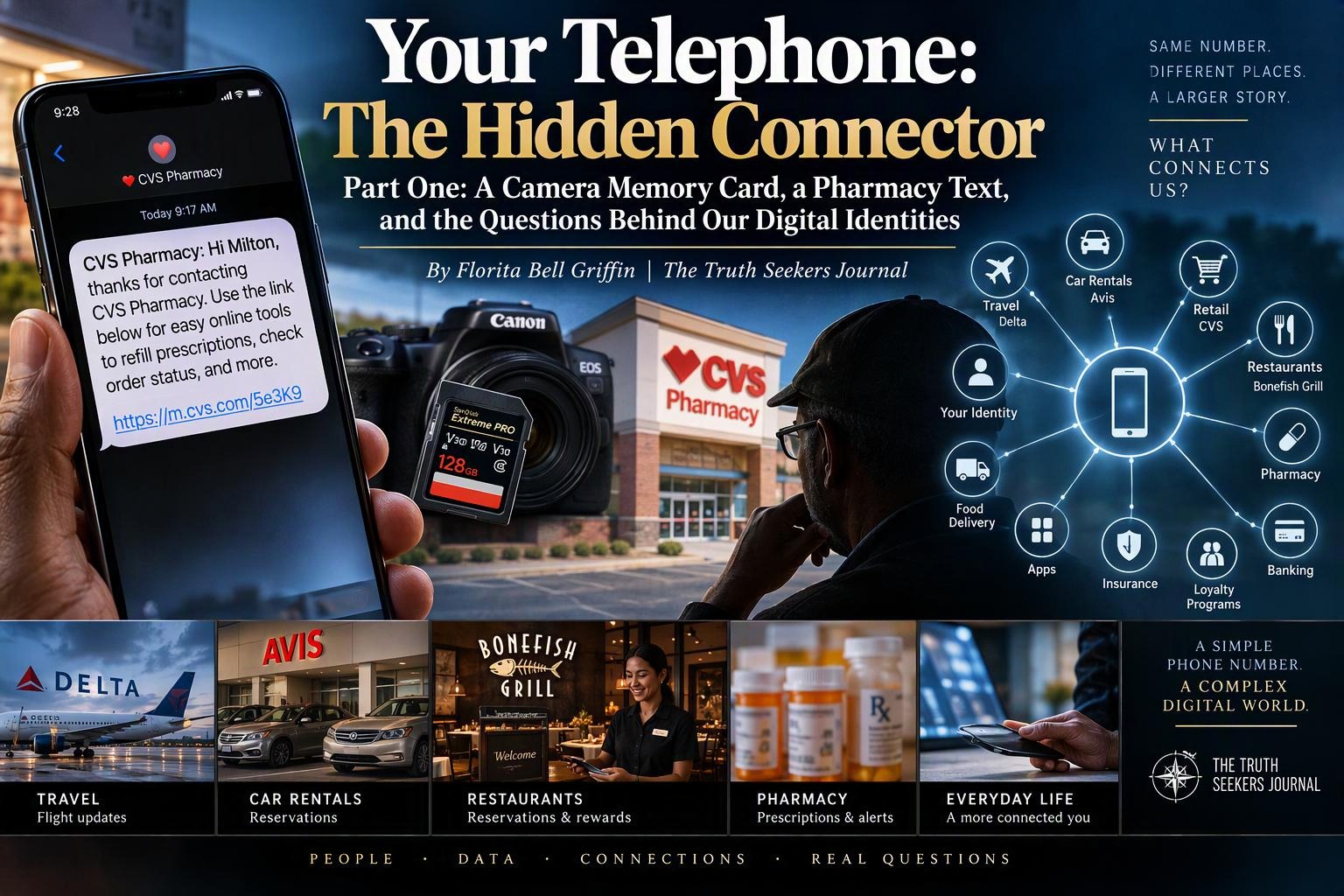
A Camera Memory Card, a Pharmacy Text, and the Questions Behind Our Digital Identities
Part One of a twelve-part series
By Florita Bell Griffin, Ph.D. | Houston, TX | November 17, 2026
On the morning of November 11, 2026, The Truth Seekers Journal publisher Milton Kirby made what should have been an ordinary telephone call to a CVS Pharmacy in Ashland, Oregon.
At approximately 8:30 a.m., Kirby wanted to know whether the store carried memory cards compatible with his Canon camera. A male store associate answered the telephone, confirmed that several options were available, and the conversation ended.
Nothing about the exchange suggested that it would become the starting point for a broader investigation into consumer privacy, corporate information systems, and the increasingly important role of telephone numbers in American life.
Less than an hour later, Kirby received an unexpected text message from CVS Pharmacy.
The message addressed him by name:
“CVS Pharmacy: Hi Milton, thanks for contacting CVS Pharmacy. Use the link below for easy online tools to refill prescriptions, check order status, and more.”
The message also included a shortened CVS-branded web link.
The communication was remarkable for two reasons. It addressed Kirby personally, although he had not verbally identified himself during the call, and it thanked him for contacting CVS Pharmacy shortly after he had done exactly that.
Yet the conversation had concerned camera memory cards, not prescriptions, medications, or pharmacy services.
How Did That Happen?
Seeking an explanation, Kirby visited the CVS location later that morning. According to his account, the operations manager explained that the store did not control the systems responsible for such communications and suggested contacting CVS corporate headquarters.
Her response provided a possible direction for further inquiry, but it did not explain why the text arrived or whether the original telephone call had triggered it.
The distinction matters.
There is no established evidence that CVS improperly accessed personal information, transferred data between retail and pharmacy systems, or violated privacy laws. The message itself contained no identifiable prescription or medical information.
What remains unexplained is the apparent relationship between an ordinary retail inquiry and a subsequent communication concerning an entirely different service.
That question became the starting point for a larger examination of something consumers use every day, often without considering its significance: their telephone number.
A Second Encounter Raises Familiar Questions
Several days after the CVS incident, Kirby experienced another revealing interaction, this time at a Bonefish Grill restaurant in Tampa, Florida.
Kirby had made the restaurant reservation online, providing his telephone number and email address as part of the process.
Justin W., an Atlanta businessman dining with Kirby and other friends, was the first member of the group to enter the restaurant.
The hostess did not initially ask whether Justin had a reservation. Instead, she requested his telephone number.
Justin provided it.
Almost immediately, the hostess addressed him by name, although he had not introduced himself.
When asked how she knew his identity, the hostess reportedly explained that his information appeared through a food-delivery platform he had previously used.
The exchange lasted only seconds.
Unlike the CVS incident, Justin had voluntarily provided his number directly to the business. Nevertheless, the speed with which the hostess apparently connected that number to his identity raised another question about the information systems operating behind everyday commercial transactions.
Kirby had supplied his own contact information when making the reservation. Justin’s identification appeared to arise from a separate interaction involving his own telephone number.
The precise technology responsible for recognizing Justin has not been established. Nor has it been determined whether a food-delivery platform, restaurant loyalty program, or another customer-management system produced the information.
However, Bonefish Grill’s published Dine Rewards materials offer a documented example of how telephone numbers can function as customer identifiers.
The company’s enrollment materials explain that telephone numbers are used to identify participating customers in its restaurants. Its rewards program also operates across several restaurant brands, including Bonefish Grill, Outback Steakhouse, Carrabba’s Italian Grill, and Fleming’s Prime Steakhouse & Wine Bar.
That disclosure does not establish that Justin participated in Dine Rewards or that the program was responsible for the hostess recognizing him.
It does establish something important: a telephone number can serve as a means of identifying a customer within an existing commercial relationship.
The two experiences were different, but together they pointed toward the same larger issue.
When did a telephone number become more than a way for someone to call us?
The Telephone Number as a Digital Identifier
For generations, telephone numbers primarily served a straightforward purpose: allowing one person to contact another.
Today, the same number may be associated with banking accounts, airline reservations, retail purchases, pharmacy services, insurance records, loyalty memberships, mobile applications, and online security procedures.
Consumers frequently retain their cellular telephone numbers for years, sometimes decades. During that time, the number can become associated with an expanding collection of accounts and transactions.
A person may provide a telephone number to receive a flight delay notification, confirm a restaurant reservation, collect loyalty points, obtain a prescription reminder, or verify access to a financial account.
Each request may seem independent.
Behind the scenes, however, the number may function as a common reference point within an organization’s information systems.
The technology used to associate records with individuals is sometimes described as identity resolution.
Identity resolution involves determining whether information contained in different records belongs to the same individual or household. Organizations may use telephone numbers, email addresses, customer account numbers, and other identifiers to make those associations.
For example, a customer who previously registered for a loyalty program might later provide a telephone number during a purchase. If the retailer’s system recognizes that number, it may retrieve the customer’s account without requiring the person to provide a name.
Such capabilities can improve customer service, support account security, and simplify transactions.
They can also create uncertainty when consumers do not understand how their information is being connected.
The central issue is not whether identifying customers through telephone numbers is inherently improper. It is whether consumers understand when and how those connections occur.
What Happens When You Make a Telephone Call?
The CVS experience introduces another dimension: information that may be available during a telephone call even when the caller does not verbally provide identifying details.
Modern telephone systems can receive information associated with incoming calls through caller identification and related communications technologies.
Depending on the telephone service, system configuration, and available customer records, an incoming number may be accessible to software used for customer service or account management.
Some organizations integrate telephone systems with customer relationship management platforms. These systems can potentially compare an incoming number with information already stored in customer databases.
If a match is found, the system may make an existing customer record available to authorized personnel or support an automated process.
These are established technological possibilities, not findings about the November 11 CVS incident.
There is currently no evidence demonstrating that CVS matched Kirby’s incoming number to an existing account, used that information to initiate a pharmacy communication, or connected his retail inquiry to a healthcare database.
The text may have resulted from an existing notification arrangement, a previously scheduled communication, an automated customer-service process, or an unrelated event that happened to occur shortly after the call.
Without information from the relevant systems, the explanation remains uncertain.
Nevertheless, the incident illustrates a significant difference between consumer expectations and the capabilities of modern communications technology.
A caller may believe the interaction consists only of a conversation with a store employee. The organization receiving the call may operate technical systems capable of processing information associated with that interaction.
Understanding the distinction is essential to understanding the hidden role telephone numbers can play.
Why the Pharmacy Message Matters
The CVS communication raised additional concerns because it referred to pharmacy services rather than ordinary retail merchandise.
Consumers generally expect healthcare information to receive greater protection than routine shopping information. Prescription records, medical histories, and treatment details may reveal sensitive personal circumstances.
CVS’s published privacy materials distinguish general retail information practices from privacy requirements associated with certain healthcare services.
The company’s retail privacy policy describes the collection of personal information through customer interactions, online services, mobile applications, and third-party sources. It also explains that information from different sources may be combined.
Telephone numbers are included among the personal identifiers covered by the policy.
Those disclosures provide useful context for understanding the company’s general information practices. They do not establish how the particular message Kirby received was generated.
CVS also publishes separate information concerning pharmacy text-messaging services. These materials describe enrollment procedures, prescription notifications, communication preferences, and methods for managing or discontinuing certain alerts.
The company explains that customers may enroll in pharmacy messaging through available services and that verification of a mobile number may be required.
These published procedures make the unanswered question more specific.
Was Kirby’s number already associated with an existing CVS account or messaging preference? Did the communication arise from a previously established relationship? Was an automated process activated by the telephone call, or was the timing coincidental?
At present, none of those possibilities has been confirmed.
The text did not reveal a diagnosis, prescription, medication, or other identifiable medical detail. It therefore should not be characterized as evidence that private medical records were exposed.
The concern is narrower but still meaningful: an unexpected pharmacy-related communication followed a retail inquiry, and the consumer could not readily determine why.
Consent: What Did the Customer Actually Agree To?
The growing use of telephone numbers as identifiers raises another question: what does it mean to give a company permission to use a telephone number?
Consumers routinely provide contact information when opening accounts, joining loyalty programs, arranging deliveries, requesting notifications, and completing transactions.
Those activities may involve agreements governing automated calls, text messages, account verification, or other communications.
CVS’s published terms address circumstances in which customers consent to certain telephone and text communications, along with methods for revoking that consent.
However, the existence of a general agreement does not establish whether Kirby authorized the particular communication he received.
A broader challenge involves the difference between formal consent and consumer understanding.
Someone may provide a telephone number for a specific purpose and later forget the agreement. An account created years earlier may remain active. A telephone number originally supplied for one service may continue to be associated with the customer under the organization’s applicable terms.
Consumers may regard each interaction as separate, while a business may manage several services within a broader customer relationship.
The legality of any particular use depends on the circumstances, the nature of the communication, applicable privacy and communications laws, and the permissions actually obtained.
But legal compliance and consumer understanding are not necessarily the same thing.
A customer may technically have agreed to certain practices without appreciating how widely a telephone number might be used within an organization’s systems.
Meaningful transparency requires more than lengthy privacy policies. Consumers need understandable explanations of how their information is collected, associated with accounts, retained, and used.
They also need practical ways to review communication preferences, correct inaccurate records, and withdraw permissions when applicable.
When Information Crosses Corporate Boundaries
Large businesses increasingly operate through interconnected technological environments.
A single company may maintain separate systems for retail transactions, customer service, mobile applications, loyalty programs, marketing, and specialized services.
Some information may be shared or combined for permitted purposes. Other information may be subject to legal, contractual, or operational restrictions.
CVS’s published California privacy disclosures, for example, address categories of personal information and circumstances involving the sale or sharing of certain identifiers under definitions established by state privacy law.
These disclosures are relevant to understanding corporate information practices, but they do not prove that Kirby’s number was sold, transferred, or disclosed to another organization.
The distinction between what a policy permits or describes and what happened in a particular incident must remain clear.
The Bonefish Grill experience raises a related issue.
Its Dine Rewards program demonstrates that customer identification can operate across multiple participating restaurant brands. A customer may interact with one business while holding an account connected to a broader rewards system.
That arrangement is not inherently improper. It is an example of how information supplied during one commercial relationship may have continuing value in another interaction within an established program.
The question for consumers is whether they understand those relationships when providing personal information.
Why Local Employees May Not Know
One of the most revealing details of the CVS experience was the operations manager’s reported inability to explain the communication.
Local employees generally handle inventory, customer assistance, purchases, and store operations. They may not have access to centralized messaging platforms, customer databases, or technical records associated with automated communications.
A message may originate from a corporate system, a specialized department, or an outside technology provider operating under an organization’s arrangements.
The employee who answers the telephone may have no role in initiating that message and no ability to determine why it was sent.
That separation helps explain why an ordinary customer inquiry can become difficult to resolve.
Consumers typically begin by asking the person or business location with which they interacted. If the relevant technology operates elsewhere, the local employee may be unable to provide a meaningful answer.
The consumer is then directed to corporate customer service, another department, or an online support process.
The challenge is not simply technological. It is organizational.
A company may possess extensive information about customer interactions while providing limited practical access to explanations about individual communications.
A consumer should not need to understand a corporation’s internal technology structure to ask why an unexpected message appeared on a cellphone.
The Added Concern of Fraudulent Messages
Unexpected corporate communications also create uncertainty because fraudulent messages frequently imitate legitimate organizations.
Scammers may use familiar company names, convincing language, and links that appear to lead to customer-service resources.
CVS publishes warnings and guidance concerning fraudulent communications that misuse its identity.
There is no evidence that the message Kirby received was fraudulent. Nevertheless, the broader problem illustrates why consumers need reliable ways to verify unexpected communications.
A message that appears to come from a familiar business may be legitimate, fraudulent, or simply misunderstood.
Consumers should avoid assuming that an unexpected message is authentic solely because it displays a recognizable name. When uncertain, they can contact the organization through an independently verified website, telephone number, or application rather than relying on links contained in the message.
Businesses also have a responsibility to make legitimate communications understandable and provide accessible methods for confirming their origin.
Artificial Intelligence and the Next Layer of Questions
Artificial intelligence introduces additional possibilities for organizations seeking to organize information, recognize patterns, automate customer service, and personalize communications.
AI systems can assist with identifying relationships among records, analyzing customer interactions, and supporting automated decisions.
However, neither the CVS incident nor the Bonefish Grill experience establishes that artificial intelligence was involved.
Traditional databases, caller identification systems, loyalty software, and rule-based automation can perform many of the functions described in these accounts without AI.
The distinction matters because the presence of automation should not automatically be interpreted as evidence of artificial intelligence.
The larger concern is accountability.
Whether a system uses conventional software or advanced AI, consumers should be able to understand the general purposes for which their personal information is used and identify appropriate channels for resolving questions.
As information systems become more sophisticated, the need for transparency becomes more important, not less.
What Consumers Can Do Now
The experiences in Oregon and Tampa illustrate why consumers may benefit from examining the role telephone numbers play in their daily activities.
Individuals can review account settings and communication preferences for services they use regularly. They can determine which telephone numbers are associated with major accounts, update outdated information, and examine available privacy choices.
They can also ask businesses whether providing a telephone number is required for a particular transaction or merely optional.
When unexpected communications arrive, consumers can preserve the message, record its timing, and contact the organization through verified channels to request an explanation.
Those steps may not reveal every connection operating within a company’s systems. They can, however, help individuals exercise greater control over information they routinely provide.
The responsibility should not rest entirely with consumers.
Corporations are better positioned to explain their own information systems and establish procedures for addressing legitimate questions about automated communications.
An Investigation That Begins With a Simple Question
The November 11 telephone call lasted only a few minutes.
The Bonefish Grill interaction was even shorter.
Neither incident establishes that a company violated privacy requirements or improperly disclosed personal information.
Yet both illustrate how ordinary interactions can reveal questions about the systems that increasingly shape consumer experiences.
A telephone number may identify an account, retrieve a customer profile, support a reservation, authorize a notification, or connect information across services.
The consumer may see only a telephone call, a request at a restaurant counter, or an unexpected text message.
What happens behind those interactions may be considerably more complex.
This article begins a Truth Seekers Journal series examining the hidden role of telephone numbers in the digital economy.
Future installments will explore caller identification technology, identity-resolution systems, corporate data sharing, consumer consent, healthcare-related privacy protections, the sale and sharing of personal identifiers, and the growing use of artificial intelligence in customer information systems.
The series will also examine what rights consumers have to access, correct, limit, or question the use of their information.
The objective is not to assume misconduct where none has been established.
It is to make visible the information practices that increasingly operate behind ordinary transactions and to encourage greater accountability where explanations are difficult to obtain.
The original question remains unanswered.
Why did a telephone call about a camera memory card precede a pharmacy-related text message?
But the investigation has already revealed a larger question worth asking:
How much of our digital identity is connected to the telephone number we carry everywhere, and how much do we really know about those connections?
© 2026 Truth Seekers Journal. Published with permission from the author. All rights reserved.
Related articles:
Will AI Change Your Job Even If It Doesn’t Replace It? What Everyday Workers Should Expect
Your Children Are Growing Up With AI: What Parents and Grandparents Need to Understand
What Happens When Your Car Starts Thinking for You? AI, Driving, and the Road Ahead
Truth Seekers Journal thrives because of readers like you. Join us in sustaining independent voices.