TSJ
TSJ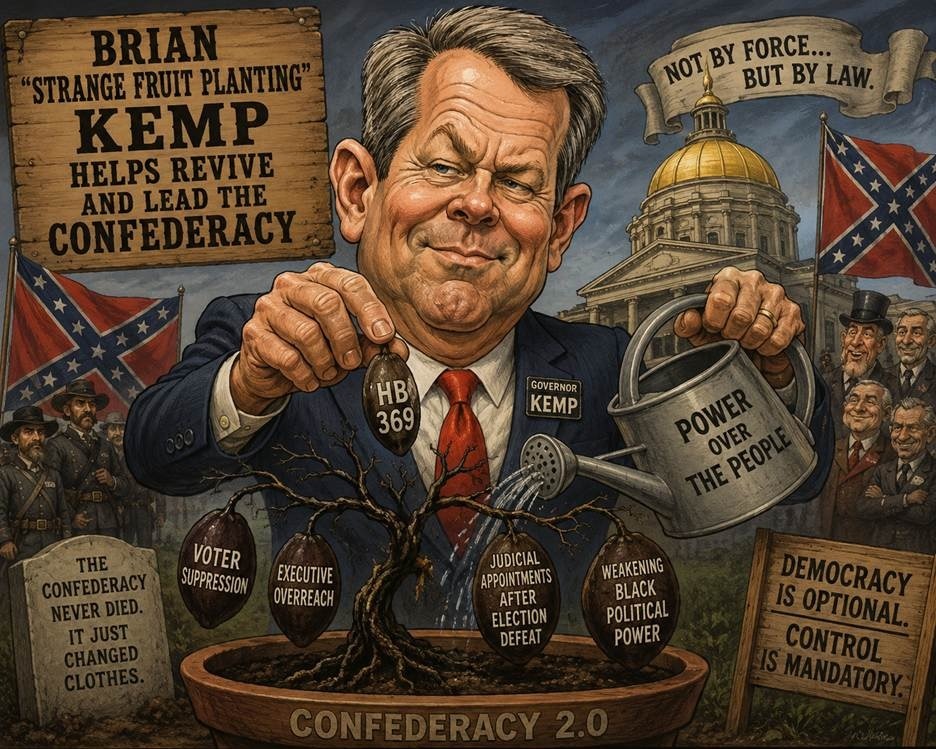
By Lola Renegade | Atlanta, GA | June 14, 2026 |
Billie Holiday’s haunting song Strange Fruit described the bodies of Black Americans hanging from Southern trees, the gruesome harvest of a nation determined to preserve White supremacy and mediocracy at any cost. The song was never merely about lynching. It was about race and power. It was about a system willing to steal Black votes, Black labor, elect should-be-prison-bound felons to local, state, and federal government, manipulate laws, institutions, courts, customs, and public opinion to maintain control. It was about a cockroach Confederacy that refuses to die. While the trees may have changed and the methods may appear more sophisticated, many Black Georgians and other states across Ameri-KKK see familiar racist fruit still being harvested from the same ancestral poisonous roots.
Last month, Fulton County voters participated in a nonpartisan election and made a choice. Judicial newcomer Nikia Smith Sellers defeated incumbent Fulton County Superior Court Judge Paige Reese Whitaker. In a democracy, elections are intended to settle questions of representation and public service. Citizens vote. Winners win. Losers lose. The people speak, and government is expected to listen. Yet, through a series of events made possible by Georgia law, Governor Brian “Strange Fruit Planting” Kemp appointed Whitaker to the Georgia Court of Appeals after her electoral defeat. That appointment creates a vacancy on the Fulton County Superior Court before Whitaker’s elected term expires, thereby giving Kemp the authority to appoint someone to a seat that many voters believed they had already filled through the democratic process.
Legally, the governor may possess the authority to make such an appointment. That is not the issue. The deeper question is whether the spirit of democracy is being honored when the outcome of an election can effectively be altered through executive appointment. Democracy requires more than legal maneuvering. It requires legitimacy. It requires respect for the will of the people. It requires public confidence that elections matter and that the voices of voters are not diminished by procedural technicalities. These are humanistic traits the unwashed in the Confederacy do not possess.
For many Georgians, particularly Black Georgians whose ancestors bled, marched, organized, and died for the right to vote, this development raises troubling concerns. It feels less like democracy in action and more like a familiar Southern tradition of finding new mechanisms to preserve political power when democratic outcomes prove inconvenient. Throughout American history, whenever Black political participation expanded, new obstacles often emerged. With the two-term election of a Black man, President Barack Obama, the Republicans have lost their minds. They are bound and determined that this will never happen again.
Following the Civil War came Black Codes. Following Reconstruction came Jim Crow. Following the Voting Rights Act came voter suppression efforts disguised as administrative reforms. The methods evolved, but the objective frequently remained the same: limiting the political impact of communities that challenged existing power structures.
Governor Kemp’s appointment of Whitaker does not stand in isolation. It comes amid broader debates about voting rights, representation, and political power in Georgia. Earlier this year, Kemp signed HB 369 into law, legislation that removes party labels from key local offices in Fulton, DeKalb, Gwinnett, Cobb, and Clayton counties beginning in 2028. Supporters argue the measure will reduce partisanship and encourage voters to focus on candidates rather than political affiliations. Critics, however, contend that the law selectively targets some of Georgia’s largest, most diverse, and heavily Democratic counties while leaving the remaining 154 counties untouched. To those critics, HB 369 represents more than election reform; it represents an effort to reshape the political landscape of metropolitan Atlanta and diminish the electoral influence of Black voters and communities of color whose participation has transformed Georgia politics in recent decades.
Whether one agrees with that assessment or not, many voters see a troubling pattern. When election rules are changed exclusively for counties with large Black and other communities of color populations, questions naturally emerge about whose political power is being targeted and whose interests are being protected. Viewed alongside actions such as the governor’s appointment of a white judge who had just been rejected by voters for a Black judge, many Blacks have seen this syndicated movie before. We see a government increasingly willing to use legal mechanisms to influence political outcomes after citizens have already spoken. For communities whose ancestors endured poll taxes, literacy tests, grandfather clauses, White primaries, and other barriers designed to dilute Black political power, such actions are not viewed as isolated events. They are viewed through the long shadow of history and as reminders that the struggle over who gets to participate fully in democracy is far from over.
Governor Brian “Strange Fruit Planting” Kemp is a racist and a pivotal part of the unwashed Confederacy. If Burt “Fake Elector” Jones or Rick “Just Another Old Ass Racist” Jackson ascend to the governor’s office in November, it will be more of the same.
The Confederacy lost the Civil War, but many would argue that it never surrendered its determination to preserve white privilege, patriarchy, hierarchy and control. Instead, it adapted. It exchanged uniforms and KKK hoods and sheets for suits, plantations and burning crosses for institutions, and overt racism for policies that often produce similar outcomes without using the same language. What once required violence now frequently relies on legislation (but violence is still on the table), court decisions, administrative procedures, and strategic appointments. The result is often the same: power remains concentrated in the hands of those who already possess it. The language is different. The mechanisms are different. The outcomes, however, often feel painfully familiar. After the (s)election of the felon Donald Trump to the presidency, racists are coming out of the woodworks, from under rocks, and from bottom feeding to boldly shout the once quiet parts out loud.
Black supporters of this racist governor should either hide their faces or plan strategies to take him down in a major way. It is evident that he played and used them like old tools. History teaches that every struggle for justice produces both freedom fighters and collaborators. While some answer history’s call with courage, others answer it with calculation. They see injustice, recognize it for what it is, and nevertheless choose personal advancement over collective liberation. Their reward may be temporary comfort, but history rarely remembers them kindly.
Some Blacks, of the Clarence Thomas, Candace Owens, and Tim Scott variety, will argue that Kemp is simply exercising powers granted to him under Georgia law. They are correct. However, legality and morality are not always the same thing. Throughout American history, many injustices were perfectly legal. Segregation was legal. Disenfranchisement was legal. Exclusion was legal. The question is not whether Governor Kemp had the authority to sign HB 369 or appoint a replacement judge. The question is whether these actions strengthen democracy, expand public trust, and honor the will of voters, or whether they reinforce a perception that political power increasingly supersedes popular sovereignty.
These controversies arrive at a moment when confidence in democratic institutions is already fragile. Across America, citizens are witnessing insurrectionists, election deniers and fake electors seeking office and winning as well as avoiding accountability, voting rights under attack, and growing distrust in public institutions. Many Americans fear that democratic norms are being weakened by a cabal of reprobates entrusted to protect them. Against this backdrop, actions that appear to circumvent the will of voters carry consequences that extend far beyond a single judicial appointment.
The struggle for Black political participation has always been a struggle to force America to honor its own promises. Voting rights were not freely given. Civil rights were not freely given. Equal access to public institutions was not freely given. Each advance required ordinary people to challenge extraordinary systems of resistance. Every generation has been called upon to defend democracy against forces seeking to narrow its reach. This time is no different.
The larger issue before Georgia is not merely who occupies a judicial seat in Fulton County. The larger issue is whether democratic outcomes will be respected when they produce results that powerful people do not prefer. Future generations will study moments like this. They will ask whether elected officials strengthened democratic institutions or weakened them. They will ask whether leaders honored the spirit of representative government or merely complied with its technical requirements. They will ask whether public office was used to expand democracy or to manage and contain it.
History will ultimately determine how this moment is remembered. The question is whether Georgia’s leaders are planting seeds that strengthen democracy or planting strange fruit that future generations will once again be forced to confront.
“When you see something that is not right, not fair, not just, you have a moral obligation to say something, to do something.” Civil Rights Activist and Congressman John Lewis
And do something we must. It is time to deliver a decisive deathblow and defeat to the lingering ideology of the Confederacy and consign it permanently to the ash heap of history. We must make sure that it never raises its ugly, vile head again.
Let us start with the rumblings of economic disturbances. Consider buying all of your gas at Costco, if possible.